
OTC Drug Facts Labels: What to Look For and How to Use Them
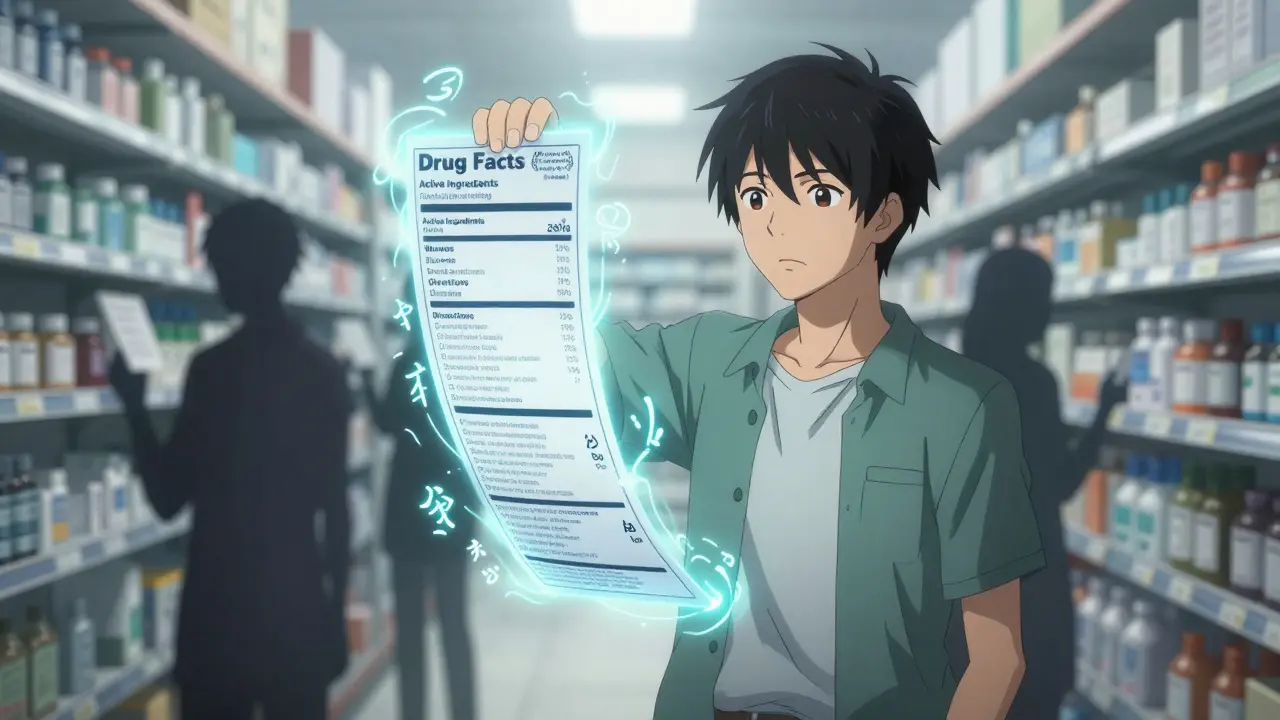
Every time you pick up a bottle of pain reliever, cold medicine, or even hand sanitizer, there’s a small but powerful piece of information staring back at you: the OTC Drug Facts label. It’s not just a sticker or a fine-print paragraph. It’s your personal safety guide - designed by the FDA to help you use over-the-counter medicines correctly, safely, and without accidentally harming yourself. Yet, most people skip it. They glance at the brand name, grab the product, and go. That’s a mistake. The Drug Facts label isn’t there to confuse you. It’s there to save you.
What Exactly Is the Drug Facts Label?
The Drug Facts label is a standardized format required by the U.S. Food and Drug Administration (FDA) for all over-the-counter (OTC) medicines. Before 1999, every company made their own label. One had the active ingredient buried in the middle. Another used confusing abbreviations. Some didn’t even list what the medicine was for. The FDA stepped in to fix this mess. They created one clear, consistent layout that every OTC product - whether it’s Tylenol, Advil, or a store-brand allergy pill - must follow. This system applies not just to pills and liquids, but also to things you might not think of as drugs: sunscreens, anti-dandruff shampoos, fluoride toothpaste, and hand sanitizers.
The format is strict. It must appear in this exact order:
- Drug Facts (the title)
- Active Ingredients
- Purpose
- Uses
- Warnings
- Directions
- Other Information
- Inactive Ingredients
There’s no wiggle room. If a product doesn’t follow this order, it’s not compliant. And if it’s not compliant, it shouldn’t be on the shelf.
Active Ingredients: The Real Name of the Medicine
This is the most important section. It tells you exactly what chemical is doing the work. Don’t rely on brand names like "NyQuil" or "Excedrin." Those are marketing names. The active ingredient is what matters. For example, Tylenol and store-brand acetaminophen both contain the same active ingredient: acetaminophen. If you take both, you’re doubling your dose - and that’s dangerous.
The label lists the amount per dose: "Each tablet contains 500 mg acetaminophen." That number is critical. Too much acetaminophen can cause liver failure. The FDA requires this to be printed clearly. If you’re taking more than one OTC product, check this section first. You might be accidentally overdosing.
Purpose: What Kind of Medicine Is This?
Under "Purpose," you’ll find the drug category. This tells you what role the active ingredient plays. Examples:
- Analgesic (pain reliever)
- Antihistamine (allergy relief)
- Decongestant (nasal congestion)
- Antacid (heartburn)
This section helps you understand why the medicine works. If you’re taking something for a headache, but the purpose says "antihistamine," you’re probably looking at an allergy medicine - not the right one. It also helps you avoid mixing drugs with the same purpose. Two decongestants together? That’s a recipe for high blood pressure.
Uses: What It’s Supposed to Treat
This section tells you exactly what symptoms the product is approved to treat. The FDA requires this to match the official OTC monograph - meaning it’s not just marketing hype. If a label says "relieves sinus pressure," that’s because the FDA has reviewed clinical data and approved that claim.
But here’s the trap: many people use these medicines for things they’re not meant for. A cold medicine labeled for "runny nose and sneezing" might be taken for a dry cough. That won’t help - and might make things worse. Always match your symptom to the "Uses" list. If your symptom isn’t listed, don’t use it.
Warnings: The Red Flags You Can’t Ignore
This is where the label gets serious. Warnings are not suggestions. They’re life-saving rules. Look for these key parts:
- "When using this product" - tells you what side effects to expect (drowsiness, dizziness, upset stomach).
- "Stop use and ask a doctor if" - lists symptoms that mean you should stop immediately (rash, nausea, worsening pain).
- "Do not use" - tells you when the product is dangerous (e.g., if you have liver disease, are pregnant, or are taking another medicine).
- "Keep out of reach of children" - required on every OTC product.
Some warnings are in red boxes. That’s intentional. The FDA mandates this for serious risks - like liver damage from acetaminophen or asthma reactions from NSAIDs. If you see a red box, read it twice. And if you’re unsure, don’t use it.
Directions: How Much, How Often, and When
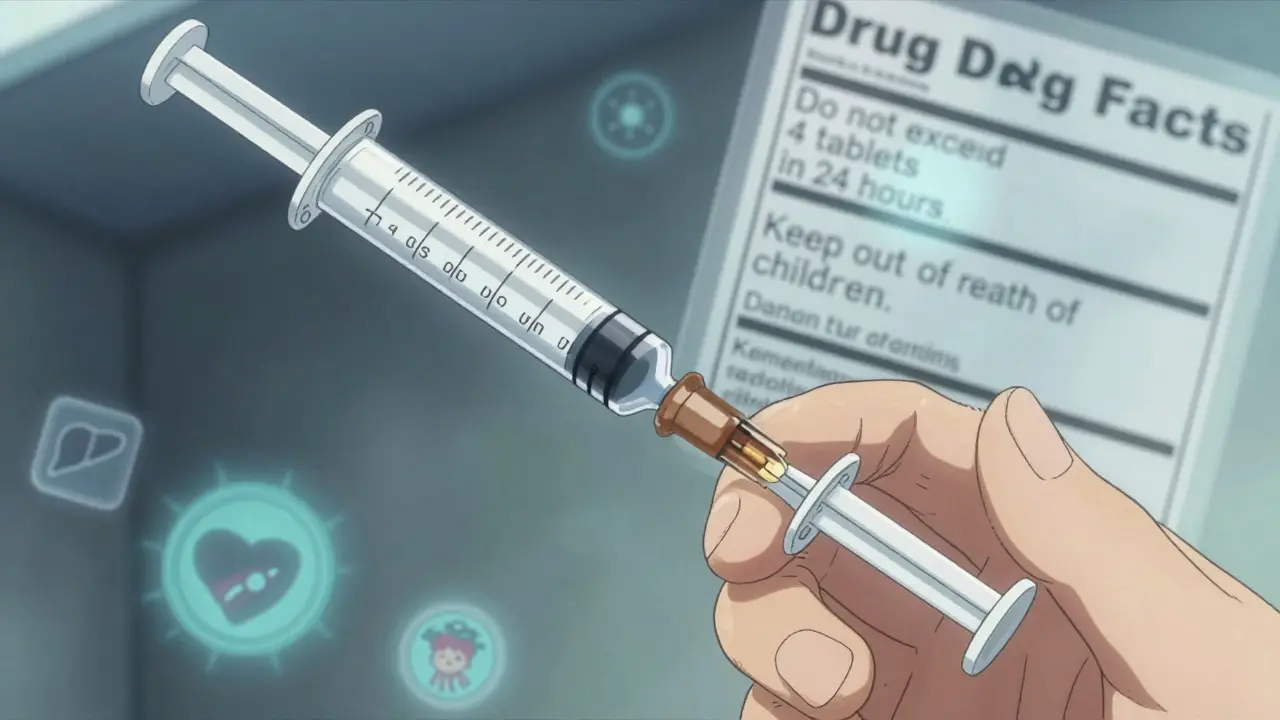
This section gives exact instructions: "Take 1 tablet every 4 to 6 hours. Do not exceed 4 tablets in 24 hours." It also includes age-specific dosing: "Children under 12: consult a doctor."
Here’s where most mistakes happen. People use teaspoons from the kitchen instead of the measuring cup that came with the medicine. A teaspoon holds 5 mL. A medicine cup might say 10 mL per dose. That’s a 100% overdose. The FDA requires all liquid doses to be listed in both metric (mL) and household (teaspoon, tablespoon) measurements - but you still need the right tool.
Also watch for "as needed" instructions. That doesn’t mean "take it whenever you feel like it." It means "take it only when symptoms return." Taking it too often - even if you feel fine - can cause harm.
Other Information: Storage and Hidden Details
This section is small, but it’s packed with useful info:
- Storage instructions (e.g., "Store at room temperature, away from moisture")
- Sodium content (for oral products: "Each tablet contains 5 mg sodium")
- Expiration date
Why does sodium matter? If you’re on a low-sodium diet for high blood pressure or kidney disease, even small amounts add up. A few antacids a day could push you over your limit. This info is required by law - but you have to look for it.
Inactive Ingredients: The Hidden Allergens
These are the fillers, dyes, and preservatives. They don’t treat your symptom - but they can cause reactions. If you’re allergic to corn, dye #5, or lactose, this section tells you if the product contains them. Many people don’t realize their allergy isn’t to the medicine - it’s to the dye or filler. If you’ve had a reaction before, always check this list.
For example, some antihistamines contain lactose. If you’re lactose intolerant, you might get stomach cramps - not from the medicine, but from the inactive ingredient.
Why This Matters: Real Numbers, Real Risks
The FDA didn’t design this system for fun. It worked. Since the Drug Facts label became mandatory in 2003:
- Medication errors from OTC drugs dropped by 27%
- Consumers who read the label were 63% less likely to have an adverse event
- 87% could correctly identify active ingredients (vs. 42% before the label)
But problems still happen. In 2022, poison control centers handled over 1.2 million OTC-related cases. The biggest mistakes? Taking too much (32%), mixing medicines with the same active ingredient (41%), and using the wrong measuring tool (27%).
How to Use the Label Like a Pro
Here’s a simple routine you can follow every time you take an OTC medicine:
- Check the active ingredient. Are you already taking another medicine with the same one? If yes, don’t double up.
- Read the warnings. Do any of them apply to you? Pregnancy? Liver disease? High blood pressure? If so, talk to a pharmacist before using it.
- Match your symptom to the "Uses" list. If it’s not listed, don’t use it.
- Use the right measuring tool. Never guess with a kitchen spoon. Use the cup or syringe that came with the medicine.
- Write down the dose and time. Especially if you’re giving medicine to a child. Keep a log for 24 hours.
And if you’re ever unsure - call a pharmacist. They’re trained to read these labels. They’ll tell you if it’s safe. No judgment. No rush.
What’s Next? Digital Labels and More
The FDA is testing new ideas. Some products now have QR codes that link to more detailed info online. Others are exploring multilingual labels to help the 25 million Americans with limited English. But the core Drug Facts format stays the same. Why? Because it works. It’s simple. It’s consistent. It’s life-saving.
Next time you reach for an OTC medicine, pause. Look at the label. Read it like it’s a map - because it is. It’s the only thing standing between you and a preventable mistake.
Do all OTC medicines have a Drug Facts label?
Yes. All OTC drugs sold in the U.S. - including pain relievers, cold medicines, antacids, sunscreens, and hand sanitizers - must have a Drug Facts label. If it doesn’t, it’s not legally allowed to be sold. Some older products from before 2003 might still be on shelves, but they’re being phased out. If you see a label that looks like an old-style paragraph, it’s likely outdated. Replace it.
Can I trust store-brand medicines as much as name brands?
Absolutely. Store brands are required to have the same active ingredients, doses, warnings, and directions as name-brand versions. The only difference is price. A generic ibuprofen tablet has the same active ingredient and dosage as Advil. The inactive ingredients might vary slightly - so if you have allergies, always check that section. But for effectiveness, they’re identical.
What if I can’t read the label because it’s too small?
Many OTC products now come in larger packaging or have a separate printed insert with full labeling. If the label is too small to read, ask your pharmacist for a printed copy. You can also look up the product name on the FDA website or use a trusted pharmacy app that displays the official Drug Facts label. Never guess what’s in a medicine just because the label is hard to read.
Is it safe to take OTC medicine with my prescription drugs?
Not always. The Drug Facts label lists drug interactions under "Warnings," but it doesn’t cover every possible combination. For example, OTC pain relievers like ibuprofen can interfere with blood pressure meds or blood thinners. Always tell your doctor or pharmacist about every OTC product you’re using - even if you think it’s "harmless." They can check for hidden risks.
Why do some labels say "Take with food" and others don’t?
It depends on how the medicine is absorbed. Some drugs, like certain NSAIDs, can irritate the stomach lining. Taking them with food reduces that risk. Others, like antihistamines, work better on an empty stomach. The "Directions" section tells you exactly what to do. If it doesn’t mention food, it’s usually fine to take it anytime. But if it says "take with food," do it. Skipping it could mean more side effects or less effectiveness.




Comments
Erin Pinheiro
February 23, 2026 AT 08:58ok but like… i read the label once and thought "acetaminophen" was a typo for "acetaminophine"?? like i swear i’ve seen it spelled 5 different ways on random drug bottles. why is this so hard?? also why does every warning say "consult your doctor" like i have time for that??
Michael FItzpatrick
February 25, 2026 AT 06:04Let me tell you something real: this label isn’t just information-it’s a lifeline. I used to think OTC meant "oh, this is trivial," until my cousin ended up in the ER because she mixed two cold meds thinking "they both say "headache relief" so it’s fine." Spoiler: it wasn’t fine. The Drug Facts label is the quiet hero no one praises. Read it like your life depends on it-because it does.
Brandice Valentino
February 25, 2026 AT 09:27Ugh. I mean, really? We’re still talking about this? It’s 2025. The FDA’s label is basically the only thing in modern medicine that doesn’t feel like a corporate marketing scam. I read it like a sacred text. I even have a highlighter for the "Warnings" section. My pharmacist calls me "The Label Queen." I wear it like a crown. 🌟
Larry Zerpa
February 26, 2026 AT 15:32You’re all missing the real issue. The FDA didn’t create this for safety-they created it to shift liability away from manufacturers. Every "Do not use" is a legal shield. Every "Consult your doctor" is a loophole. The label looks helpful, but it’s designed to absolve companies while leaving consumers drowning in fine print. And don’t get me started on how "inactive ingredients" are buried like a trap. This isn’t transparency-it’s obfuscation with a badge.
Dominic Punch
February 27, 2026 AT 06:40For real though-this is the most underappreciated public health tool ever. I work in pharmacy and I see people take 4 different meds at once, none of which should be mixed. The label is your cheat sheet. I keep printed copies in my wallet. If you can’t read it? Ask. Don’t guess. I’ve seen people die because they thought "extra strength" meant "double dose." It doesn’t. It means "same dose, fewer pills." Simple. But you gotta pay attention.
Jacob Carthy
February 27, 2026 AT 14:33Who even cares about this label? I just take what works. If it says "pain relief" and I got pain I take it. If I feel weird I stop. End of story. All this reading is just making people paranoid. We used to live without this crap and we were fine.
Haley Gumm
February 27, 2026 AT 17:11My grandma taught me to read the label before I even knew what "active ingredient" meant. She’d say "If you don’t know what’s in it, you don’t own it." I still do it. Even for hand sanitizer. I check for alcohol content and if it’s got weird dyes. I once refused a free sample because it had FD&C Red 40. She’d be proud.
Gabrielle Conroy
March 1, 2026 AT 12:43OMG YES!!! 🙌 I keep a little notebook where I write down every OTC I take and why-active ingredient, time, dose, and even the expiration date. I use emoji too: 💊 for pills, 🚫 for warnings, 📏 for measurements. My pharmacist says I’m her "model patient." I just think it’s common sense! And if you’re taking something with lactose and you’re intolerant?? You’re basically eating a ticking time bomb. Check the inactive ingredients!! 🧠
Spenser Bickett
March 2, 2026 AT 22:54So we’re celebrating a government-mandated label like it’s the Magna Carta? Cute. The real truth? Most people still can’t read it. And the ones who can? They’re the same ones who already take 17 supplements and think "natural" means "safe." The label didn’t fix anything-it just gave people a false sense of security while Big Pharma kept selling the same pills in new packaging. Congrats, we made bureaucracy look like a hero.
Christopher Wiedenhaupt
March 3, 2026 AT 05:07It is important to note that the standardization of the OTC Drug Facts label has significantly improved public health outcomes. The clarity and consistency it provides enable consumers to make informed decisions. While some may find the format overly detailed, the inclusion of active ingredients, dosage instructions, and contraindications is essential for minimizing adverse events. I recommend always cross-referencing with a licensed pharmacist when in doubt.