
Cough Suppressants and MAOIs: Dextromethorphan Interaction Risks

MAOI-Dextromethorphan Safety Checker
Is it safe to take dextromethorphan after stopping your MAOI?
MAOIs bind tightly to enzymes in your body, and it takes at least 14 days for your system to replace them. Taking dextromethorphan during this window can trigger life-threatening serotonin syndrome.
If you're taking an MAOI for depression or Parkinson’s, your cough medicine could be dangerous - even deadly. Many people don’t realize that a common over-the-counter cough suppressant, dextromethorphan, can trigger a life-threatening reaction when mixed with MAOIs. This isn’t a rare edge case. It’s a well-documented, high-risk interaction that kills people every year - and most of those cases happen because no one ever told them.
What Exactly Is Dextromethorphan?
Dextromethorphan is the active ingredient in dozens of cough syrups, pills, and lozenges you can buy without a prescription. Brands like Robitussin, Delsym, and Vicks Formula 44 all contain it. It’s been used since the 1950s to calm dry, nagging coughs. It doesn’t treat the cause of the cough, but it stops the reflex that makes you cough. That’s why it’s so popular.
But dextromethorphan isn’t just a simple cough suppressant. It works by affecting brain chemicals - specifically, it blocks the reuptake of serotonin. That means it leaves more serotonin floating around in your nervous system. That’s fine on its own. But when you add another drug that does the same thing… things get risky.
What Are MAOIs?
MAOIs - monoamine oxidase inhibitors - are a class of antidepressants developed in the 1950s. They’re not the first choice anymore because newer drugs like SSRIs have fewer side effects. But they still matter. For some people with treatment-resistant depression, bipolar disorder, or even Parkinson’s disease, MAOIs are the only thing that works.
Common MAOIs include phenelzine (Nardil), tranylcypromine (Parnate), selegiline (Zelapar, Emsam), and rasagiline (Azilect). These drugs stop your body from breaking down serotonin, norepinephrine, and dopamine. That’s how they lift mood. But that same mechanism becomes a problem when you take dextromethorphan on top of them.
Why the Combination Is Dangerous
Both dextromethorphan and MAOIs increase serotonin levels. Together, they push serotonin way past safe limits. That’s when serotonin syndrome kicks in.
Serotonin syndrome isn’t just a bad stomachache. It’s a medical emergency. Symptoms can show up within hours - sometimes as fast as 30 minutes after taking the cough medicine. They include:
- High fever (103°F or higher)
- Muscle rigidity or twitching
- Fast heart rate, high blood pressure
- Confusion, agitation, hallucinations
- Shivering, sweating
- Nausea, vomiting, diarrhea
- Seizures or loss of consciousness
Severe cases can lead to organ failure, brain damage, or death. A 2022 review in the PMC journal found that between 2% and 12% of people who develop severe serotonin syndrome don’t survive - even with hospital care.
It’s not just serotonin, either. MAOIs also interfere with the liver enzyme CYP2D6, which normally breaks down dextromethorphan. When that enzyme is blocked, dextromethorphan builds up in your blood - sometimes 3 to 4 times higher than normal. That means even a normal dose can become toxic.
Real Cases, Real Consequences
This isn’t theoretical. People are dying from this mix.
The FDA’s Adverse Event Reporting System recorded 237 cases between 2010 and 2022 where serotonin syndrome was linked to dextromethorphan and MAOIs. Over 40% of those cases needed hospitalization. One Reddit user on r/MAOI described waking up with a 104°F fever, muscles locked like stone, and no idea what was happening. Another person on PatientsLikeMe took a nighttime cold syrup while on Parnate. Four hours later, they couldn’t speak. ER doctors told them they were lucky to be alive.
And here’s the scary part: most of these people didn’t know they were at risk. A 2019 survey found that 78% of MAOI users had no idea that common cough medicines contained dextromethorphan. They thought it was just a harmless cold remedy.

How Long Should You Wait?
You can’t just wait a day. You can’t wait a few hours. You need to wait at least two weeks after your last dose of an MAOI before taking dextromethorphan. Why? Because MAOIs bind tightly to the enzymes they block. It takes time for your body to make new enzymes to replace them.
And it works the other way, too. If you’ve taken dextromethorphan recently, you still need to wait two weeks before starting an MAOI. That’s why pharmacists and doctors always ask: “Have you taken any cough medicine in the last two weeks?”
The Therapeutic Goods Administration in Australia, the FDA in the U.S., and the European Medicines Agency all agree: do not use dextromethorphan with, or within two weeks of, an MAOI.
What About Other Medications?
Dextromethorphan isn’t the only risk. Many other OTC and prescription drugs can also raise serotonin levels. Fluoxetine (Prozac), paroxetine (Paxil), and even some antibiotics like linezolid can make the interaction worse. Some anti-nausea drugs, painkillers like tramadol, and even certain herbal supplements like St. John’s Wort are dangerous too.
If you’re on an MAOI, you need to treat every new medication - even something you buy at the grocery store - like a potential bomb. Always check with your pharmacist before taking anything new.
What Can You Take Instead?
You don’t have to suffer through a cough. There are safe alternatives.
- Guaifenesin - This is an expectorant that helps loosen mucus. It doesn’t affect serotonin. Look for products labeled “guaifenesin only” - no dextromethorphan.
- Honey - A spoonful of honey before bed can soothe a cough. It’s as effective as dextromethorphan for nighttime coughs, according to studies in the BMJ. But avoid honey that’s been mixed with other ingredients - some contain tyramine, which can also interact with MAOIs.
- Steam and hydration - Warm showers, humidifiers, and sipping warm tea can help clear your airways.
Even these options need caution. Some honey products, especially imported ones, may contain traces of tyramine. Always choose plain, pasteurized honey. And if you’re unsure, ask your pharmacist.
Pharmacists Are Your Best Defense
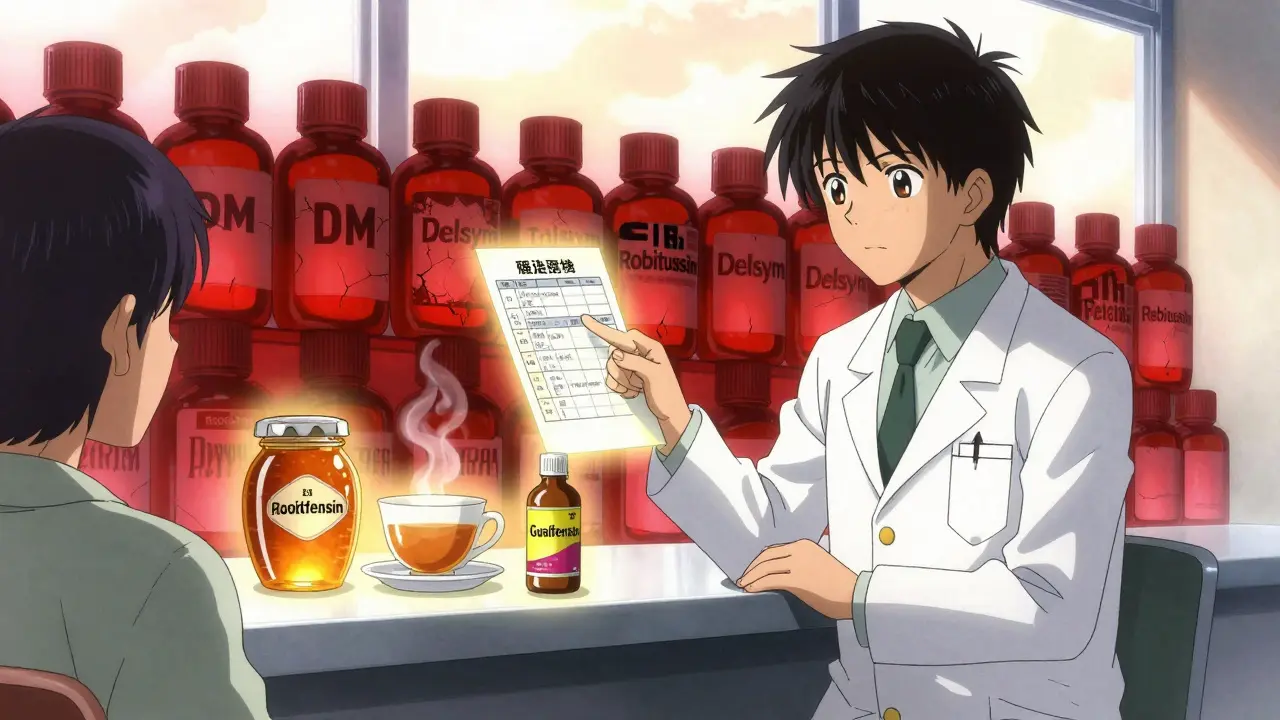
A 2021 study showed that when pharmacists actively counseled MAOI users about OTC risks, accidental interactions dropped by 67%. That’s huge. But only 43% of patients get this kind of counseling when they start an MAOI.
Don’t assume the pharmacist will ask. Bring your list. Say: “I’m on an MAOI. Can you check if this cough medicine is safe?”
Pharmacists have access to drug interaction databases. They can spot hidden dangers. They’ve seen this happen too many times. They’re trained to catch it - if you give them the chance.
Label Warnings Are Still Too Weak
Even though the FDA requires MAOI warnings on dextromethorphan labels, a 2021 review found only 38% of products display them prominently. Many labels bury the warning in tiny print on the back. Some don’t mention MAOIs at all.
The FDA proposed stronger labeling in 2022 - bigger fonts, clearer language, a warning box. Implementation was expected by late 2024. But if you’re reading this in March 2026 and still see vague warnings… you’re not alone. Many products haven’t changed yet.
Don’t rely on the label. Always ask.
What’s Changing in 2026?
MAOI use is rising. Since 2020, prescriptions for MAOIs have gone up 22% as doctors turn to them for treatment-resistant depression. That means more people are at risk.
Newer MAOIs like moclobemide (not available everywhere) are reversible and appear to have a lower risk. But the traditional ones - the ones most people are on - are still the most dangerous.
The European Medicines Agency now requires that every MAOI prescription come with a printed list of dangerous OTC drugs, including brand names of cough medicines that contain dextromethorphan. The U.S. is moving toward that too.
But until then, the responsibility falls on you.
Final Advice
If you’re on an MAOI:
- Never take dextromethorphan - not even once.
- Check every cough, cold, or flu product - even “natural” ones.
- Wait at least two weeks after stopping an MAOI before using dextromethorphan.
- Wait two weeks after using dextromethorphan before starting an MAOI.
- Carry a list of your medications - including supplements - and show it to every pharmacist.
- Teach someone close to you what to look for. Serotonin syndrome can happen fast. You might not be able to call for help.
This isn’t about being paranoid. It’s about being informed. A simple cough medicine can kill you if you don’t know the risks. And if you’re taking an MAOI, you’re already carrying a hidden danger. Don’t add another one.
Can I take dextromethorphan if I stopped my MAOI a week ago?
No. Even if you stopped your MAOI a week ago, you still need to wait at least two weeks. MAOIs bind tightly to enzymes in your body, and it takes that long for your system to replace them. Taking dextromethorphan too soon can still trigger serotonin syndrome.
Is it safe to use dextromethorphan with other antidepressants like SSRIs?
No. Dextromethorphan should not be combined with SSRIs (like sertraline or fluoxetine) either. Both raise serotonin levels, and the combination can still cause serotonin syndrome. Always check with your doctor before mixing any antidepressant with cough medicine.
What if I accidentally took dextromethorphan while on an MAOI?
Call emergency services or go to the nearest ER immediately. Do not wait for symptoms. Serotonin syndrome can worsen rapidly. Tell them exactly what you took and when. Early treatment with muscle relaxants and cooling measures can save your life.
Are there any cough medicines that are completely safe for MAOI users?
Yes - but only if they contain guaifenesin and nothing else. Look for products labeled "guaifenesin only." Avoid any product with "DM," "dextro," "cough suppressant," or "multi-symptom." Even some "natural" cough drops contain hidden ingredients. Always check the active ingredients list.
Why don’t more people know about this risk?
Because the warning isn’t loud enough. Many OTC labels bury the MAOI warning in fine print. Doctors don’t always discuss it. Patients assume cough medicine is safe. A 2019 survey found 78% of MAOI users didn’t know dextromethorphan was risky. Education gaps like this cost lives.




Comments
Dylan Patrick
March 16, 2026 AT 23:12I took Robitussin last winter without knowing I was at risk. Thank god I only had a mild headache. This post saved my life. Never again.
Aaron Leib
March 17, 2026 AT 13:18I'm on Nardil and I always double-check every OTC med. Pharmacists don't always volunteer this info. You have to ask. Always.
Kathy Leslie
March 18, 2026 AT 11:49I had no idea honey was actually a legit alternative. I've been using it for weeks now. My cough is gone and I'm not scared to sleep.
Amisha Patel
March 19, 2026 AT 07:26In India we use cough syrups without thinking. This is eye opening. I'll show this to my mom who's on Parnate. Thank you for writing this.
Elsa Rodriguez
March 19, 2026 AT 21:26I'm just here to say that if you're on an MAOI and you still take dextromethorphan... you're basically playing Russian roulette with your brain. And I'm not being dramatic. I'm being factual.
Tim Schulz
March 21, 2026 AT 13:18LMAO so the FDA's 'stronger labeling' is just a fancy way of saying 'we tried'? 😂 Still buried in 6pt font like a secret cult ritual.
Jinesh Jain
March 23, 2026 AT 07:08I've been on selegiline for 3 years. I use guaifenesin exclusively. Simple. Safe. No drama. Why make it complicated?
douglas martinez
March 23, 2026 AT 14:53The two-week washout period is non-negotiable. This is not a suggestion. It is a physiological reality grounded in enzyme kinetics and pharmacokinetic half-lives. Ignoring it is not bravery - it is negligence.
Emma Deasy
March 24, 2026 AT 14:07I can't believe this isn't on every single cough medicine bottle in giant red letters. It's not just negligence - it's systemic failure. People are dying because of corporate indifference and regulatory inertia. This needs to be a public health crisis headline.
tamilan Nadar
March 26, 2026 AT 03:13In Tamil Nadu, we use herbal syrups made from tulsi and ginger. No chemicals. No risk. But I still tell my friends on MAOIs to avoid anything with 'DM' - even if it says 'natural'.
Rosemary Chude-Sokei
March 27, 2026 AT 23:57I'm an MAOI user and I carry a printed list of unsafe medications in my wallet. I hand it to every pharmacist. It's not paranoia. It's preparedness. And if you're not doing this, you're putting yourself at unnecessary risk.
Noluthando Devour Mamabolo
March 28, 2026 AT 03:43This is a classic pharmacokinetic nightmare. CYP2D6 inhibition + MAOI-induced serotonin accumulation = perfect storm. The 2-week washout isn't arbitrary - it's based on enzyme turnover kinetics. You're not being overly cautious - you're being scientifically literate.
Sabrina Sanches
March 28, 2026 AT 21:34I just started MAOI last month and I didn't know ANY of this. Thank you. Thank you. Thank you. I'm telling everyone I know.