
Medications in Heart Failure: What You Need to Monitor Closely
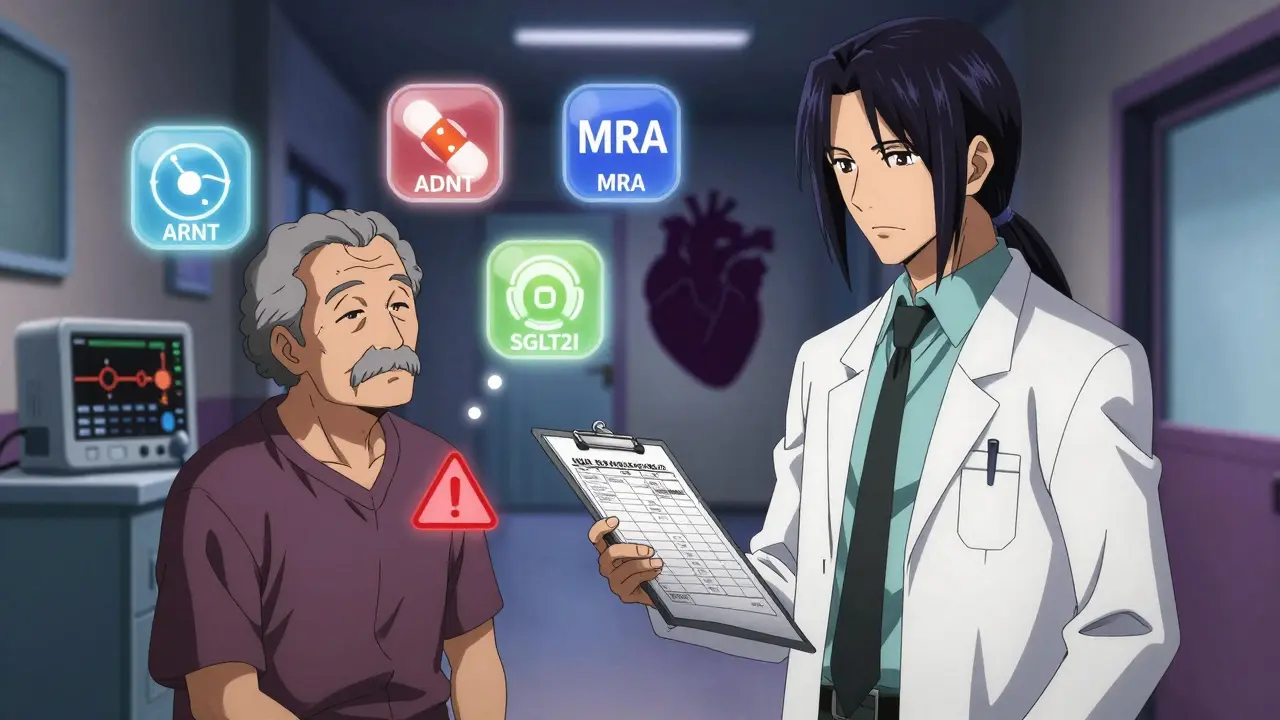
Heart Failure Medication Monitoring Calculator
Monitoring Schedule Calculator
Personalized Monitoring Recommendations
Medication-Specific Monitoring
Special Considerations
Urgent Action Items
Heart failure isn’t just about a weak heart. It’s about a delicate balance of medications that can save lives-or cause serious harm if not watched carefully. Four key drug classes form the backbone of modern treatment: angiotensin receptor-neprilysin inhibitors (ARNIs), beta-blockers, mineralocorticoid receptor antagonists (MRAs), and sodium-glucose cotransporter-2 inhibitors (SGLT2i). Together, they’re called guideline-directed medical therapy, or GDMT. But getting these drugs to their full power isn’t as simple as prescribing them. Each one needs its own monitoring plan, especially in older adults, women, non-Caucasian patients, and those with kidney issues.
Why Monitoring Matters More Than You Think
Only 30 to 40% of heart failure patients get all four GDMT drugs at the right doses. That’s not because doctors don’t know the guidelines-it’s because monitoring feels overwhelming. A 2023 study in JACC: Heart Failure found that 68% of eligible patients never even start MRAs, mostly out of fear of high potassium levels. But skipping these drugs means missing out on a 30% drop in death risk. The problem isn’t the meds-it’s the missed checkups.
Real-world data shows that when monitoring is built into routine care-like pharmacist-led titration or EHR alerts-target doses are achieved in over 60% of patients, up from under 30%. This isn’t theoretical. It’s what happens when systems change.
Beta-Blockers: Slowing the Heart to Save It
Beta-blockers like carvedilol, bisoprolol, and metoprolol succinate are among the most effective drugs for heart failure. But they don’t work if you don’t titrate them slowly to target doses. The goal? A resting heart rate between 50 and 60 beats per minute. Too fast, and the heart keeps working too hard. Too slow, and you risk dizziness or low blood pressure.
Start low. Go slow. Check heart rate and blood pressure every 1 to 2 weeks after each dose increase. If the heart rate stays above 70 even after maxing out the beta-blocker, add ivabradine. But here’s the catch: if the patient is over 75 or has a slow heart rhythm, start ivabradine at 2.5 mg twice daily-not the usual 5 mg. And never combine it with strong CYP3A4 inhibitors like clarithromycin or ketoconazole-those can spike ivabradine levels by 3 times, raising the risk of dangerous slow heart rhythms.
MRAs: The Potassium Trap
Spironolactone and eplerenone are lifesavers. They cut heart failure deaths by 30%. But they also raise potassium. And high potassium can trigger cardiac arrest.
Check serum potassium before starting. Then again in 3 to 7 days. After that, every 3 to 6 months if stable. But if the patient has kidney disease, is on ACE inhibitors, or is non-Caucasian, check even more often. Studies show non-Caucasian patients have a 15.3% chance of hyperkalemia with MRAs-nearly double that of White patients. That’s not a coincidence. It’s biology.
Also watch diuretics. If you increase a loop diuretic like furosemide, potassium might drop. If you cut it, potassium might climb. It’s a tightrope. That’s why pharmacist-led teams-those who track labs and adjust doses daily-are making a real difference. In pilot programs, they cut MRA discontinuations by 35% just by catching potassium spikes early.

SGLT2 Inhibitors: The Quiet Game-Changer
Dapagliflozin and empagliflozin were originally diabetes drugs. Now they’re first-line for heart failure-even if the patient doesn’t have diabetes. They reduce hospitalizations by 30% and cut death risk in both HFrEF and HFpEF.
But they’re not risk-free. The big concern? Volume loss. Especially in older adults. If someone’s on a diuretic and starts an SGLT2 inhibitor, they can get too dry. Symptoms: dizziness, low blood pressure, kidney trouble. Monitor weight daily. If they lose more than 2 pounds in 2 days, hold the dose and check for dehydration.
Also watch for genital yeast infections. In trials, 11.9% of patients got them-almost 3 times more than placebo. That’s not rare. It’s common. Tell patients to keep the area clean and dry. And yes, diabetic ketoacidosis can happen-even with normal blood sugar. It’s called euglycemic DKA. It’s rare, but deadly if missed. If someone feels nauseous, breathless, or confused, check ketones. Don’t wait for high glucose.
ARNIs: The Blood Pressure Balancing Act
Sacubitril-valsartan replaces ACE inhibitors and ARBs in most cases now. It’s more effective. But it’s also more likely to cause low blood pressure. In the PARADIGM-HF trial, 14% of patients on sacubitril-valsartan had symptomatic hypotension-compared to 9.2% on enalapril.
Check blood pressure within 1 to 2 weeks of starting or increasing the dose. If systolic pressure drops below 90 mmHg and the patient feels lightheaded, hold the dose. Don’t just reduce it-wait until the patient stabilizes. Also, never switch from an ACE inhibitor to an ARNI within 36 hours. That combo can cause life-threatening swelling of the face and throat.
And women? They have 30% higher drug exposure. That means they’re more likely to get low blood pressure. Start at half the usual dose. Titrate slower. Monitor closer.

Special Populations: One Size Doesn’t Fit All
Older adults (75+) need lower starting doses of ivabradine and slower titration of ARNIs. Women need lower ARNI doses and closer monitoring for hypotension. Non-Caucasian patients need more frequent potassium checks on MRAs. Patients with kidney disease? Avoid MRAs if creatinine is above 2.5 mg/dL or potassium above 5.0 mEq/L. But don’t just stop them-reassess every 3 months. Many can tolerate lower doses.
And don’t forget device monitoring. Implantable sensors that track lung pressure can cut hospitalizations by 30%. But they’re only used in 1.2% of eligible patients. Why? Cost, complexity, lack of training. But new AI tools are emerging-some can predict high potassium risk from lab trends with 83% accuracy. That’s not science fiction. It’s here.
The Bottom Line: Monitoring Is Part of the Treatment
Heart failure meds aren’t like antibiotics. You don’t take them for 7 days and call it done. They need constant tuning. The best drug in the world does nothing if it’s not monitored properly.
Start with a checklist: heart rate for beta-blockers, potassium for MRAs, weight and symptoms for SGLT2i, blood pressure for ARNIs. Add in patient education: tell them what to watch for. Use tools-pharmacists, EHR alerts, remote weight scales. And don’t give up on patients who miss a lab. Reconnect. Adjust. Try again.
By 2030, heart failure care will be personalized. Genetic tests, continuous sensors, AI-driven alerts-all of it will be standard. But for now, the most powerful tool is still the human one: paying attention.
How often should potassium be checked when starting an MRA for heart failure?
Check serum potassium before starting the MRA, then again within 3 to 7 days after the first dose or any dose increase. After that, monitor every 3 to 6 months if levels are stable. For high-risk patients-like older adults, non-Caucasian individuals, or those with kidney disease-check every 2 weeks for the first month, then monthly until stable.
Can SGLT2 inhibitors be used in patients without diabetes?
Yes. SGLT2 inhibitors like dapagliflozin and empagliflozin are now recommended for all heart failure patients with reduced or preserved ejection fraction-even if they don’t have diabetes. They reduce hospitalizations and death by improving how the heart and kidneys handle fluid and energy. Their benefit isn’t tied to blood sugar control.
Why is ivabradine only used after beta-blockers?
Ivabradine slows the heart rate, but it doesn’t improve survival like beta-blockers do. Beta-blockers are the first-line choice because they reduce death and hospitalizations. Ivabradine is only added if the heart rate stays above 70 beats per minute after the patient has reached the maximum tolerated beta-blocker dose. It’s a backup, not a replacement.
What’s the biggest reason patients stop taking MRAs?
Fear of high potassium. Many patients and providers stop MRAs because of one elevated potassium level-even if it’s mild and easily fixed. But stopping these drugs increases death risk by 30%. The key is monitoring, not avoidance. With proper checks and dose adjustments, most patients can stay on them safely.
Do I need to monitor SGLT2 inhibitors differently in elderly patients?
Yes. Elderly patients are more prone to volume loss and low blood pressure when starting SGLT2 inhibitors. Monitor weight daily for the first 2 weeks. If they lose more than 2 pounds in 48 hours, check for dehydration and consider holding the dose. Also, watch for dizziness or falls. Start at the lowest dose and titrate slowly.
Can I switch from an ACE inhibitor to an ARNI right away?
No. Switching directly from an ACE inhibitor to an ARNI carries a risk of angioedema-dangerous swelling of the face, tongue, or throat. Wait at least 36 hours after the last ACE inhibitor dose before starting the ARNI. This rule applies even if the patient was on a low dose.
What’s the most effective way to improve GDMT adherence in practice?
Pharmacist-led titration programs. In one study, having pharmacists manage dose increases and lab monitoring raised the percentage of patients reaching target doses from 28% to 63% in just 6 months. They catch issues early, adjust doses safely, and educate patients. When combined with EHR alerts for potassium or blood pressure, outcomes improve dramatically.
What’s Next for Heart Failure Monitoring?
Future tools are coming fast. Continuous potassium patches-worn like a bandage-are in late-stage trials and match lab results 92% of the time. AI systems are learning to predict who’s likely to develop hyperkalemia before it happens. Smartphone apps are helping patients log symptoms and weights, boosting adherence by 27%.
But none of these replace the need for careful, consistent care. The best monitoring system is still a clinician who knows the patient, checks the labs, asks the right questions, and doesn’t let fear stop a life-saving medication.





Comments
Christine Détraz
December 24, 2025 AT 15:06Really appreciate how this breaks down the real-world barriers to GDMT. I’ve seen so many patients get dropped from MRAs after one borderline K+ level, and it’s heartbreaking. The 30% mortality reduction isn’t theoretical-it’s their next birthday.
Pharmacist-led titration is the unsung hero here. We need more of that in primary care, not just cardiology clinics.
Jillian Angus
December 26, 2025 AT 10:12My grandma was on spironolactone and they pulled it because her K+ was 5.1. She died six months later. No one ever told us it could be managed. This should be mandatory reading for every med student.
CHETAN MANDLECHA
December 28, 2025 AT 09:24As someone who’s seen this in rural India-patients stop MRAs because they hear ‘high potassium’ and think ‘poison’. We need simple infographics. Not just guidelines. People aren’t doctors.
Also, SGLT2i side effects? We tell them it’s ‘sugar pill’ and they’re confused. Need better patient language.
EMMANUEL EMEKAOGBOR
December 30, 2025 AT 02:55This is one of the most clinically nuanced pieces I’ve read in years. The emphasis on non-Caucasian patients and potassium risk is critical. In Nigeria, we see hyperkalemia in 20% of MRA users-often because we don’t have daily labs. But even monthly checks make a difference.
Also, the point about ivabradine and CYP3A4 inhibitors? I had a patient on ketoconazole for fungal infection. We almost missed it. Thank you for highlighting this.
niharika hardikar
December 30, 2025 AT 19:01It is imperative to underscore that guideline-directed medical therapy, when properly implemented, constitutes the gold standard in contemporary heart failure management. The statistical disparities in MRA utilization, particularly among non-Caucasian cohorts, reflect systemic failures in clinical vigilance and pharmacovigilance.
Moreover, the assertion that euglycemic diabetic ketoacidosis may occur in the absence of hyperglycemia necessitates heightened clinical awareness and routine ketone screening in patients presenting with nonspecific symptoms. Failure to do so constitutes a breach of the standard of care.
Pankaj Chaudhary IPS
December 31, 2025 AT 00:42As an officer who’s seen how systems fail people, I say this: we don’t need more drugs-we need more follow-up. In India, patients get discharged with a script and a prayer. No one checks their weight. No one calls. No one cares.
Pharmacists should be the frontline. Train them. Pay them. Let them do their job. And stop blaming patients for not understanding jargon they’ve never heard before.
Bhargav Patel
January 2, 2026 AT 00:16The real tragedy isn’t the lack of drugs-it’s the lack of patience. We rush to titrate, to optimize, to hit targets, but we forget that the heart doesn’t respond to calendars. It responds to time, to trust, to consistency.
What if we stopped seeing GDMT as a checklist and started seeing it as a conversation? A dialogue between patient and provider that unfolds over weeks, not visits?
And yes-women do have higher ARNI exposure. But we rarely adjust for it. Why? Because guidelines don’t say ‘start lower’. They say ‘titrate to target’. But target doesn’t mean the same for everyone.
There’s science here. And then there’s humanity. We need both.
Ajay Sangani
January 2, 2026 AT 02:07so like… if you stop mras because of high k+… you’re basically choosing death over a number? and we wonder why outcomes are bad?
also… sgl2 inhibitors for non diabetics… mind blown. why did it take so long?
and why is no one talking about the fact that women are getting more side effects but we dont adjust doses? its like medicine was designed for a 70kg male in 1985
Aurora Daisy
January 2, 2026 AT 08:37Oh look, another American medical article that thinks ‘monitoring’ means ‘do more labs’ and not ‘pay your nurses more’. In the UK, we’ve had community pharmacists managing anticoagulants for 20 years. We don’t need AI to predict potassium-we need someone to pick up the phone.
Also, ‘non-Caucasian’? We call them ‘people of colour’ here. And yes, we know they’re at higher risk. But you don’t need a 2023 JACC paper to tell you that. You need to stop treating brown bodies like lab rats.
Isaac Bonillo Alcaina
January 3, 2026 AT 06:18Most of these patients shouldn’t even be on four drugs. They’re overmedicated, under-monitored, and poorly educated. The fact that 68% never start MRAs isn’t because of fear-it’s because the prescribing physician doesn’t understand the risk-benefit ratio themselves.
And you mention ‘euglycemic DKA’ like it’s a novel concept. It’s been in case reports since 2015. If you’re not screening for ketones in heart failure patients on SGLT2i, you’re not practicing medicine-you’re gambling.