
Fiber for GI Health: Soluble vs. Insoluble Choices
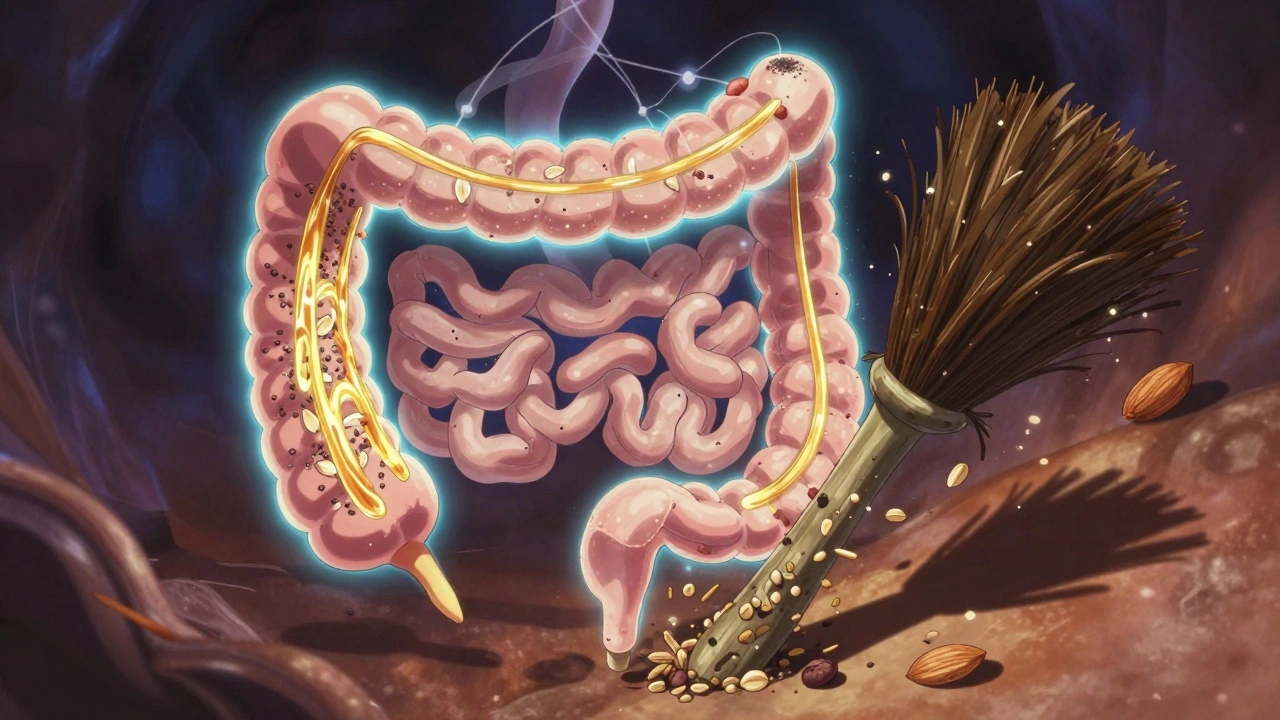
Most people know fiber is good for you-but few know how it actually works inside your gut. The truth is, not all fiber is the same. Two types-soluble and insoluble-do completely different jobs, and getting the balance right can mean the difference between regular digestion and constant bloating, constipation, or even mood swings. If you’ve ever felt like your stomach is a mystery box, it’s probably because you’re missing one of these two key players.
What Soluble Fiber Actually Does
Soluble fiber doesn’t just pass through your system. It turns into a thick, gel-like substance when it hits water. Think of it like oatmeal soaking up liquid-it swells up and slows everything down. That’s exactly what it does in your intestines. This gel traps sugars and fats as they move through your gut, which helps keep your blood sugar from spiking after meals. Studies show this can cut post-meal glucose spikes by 20-30%. That’s why people with prediabetes or type 2 diabetes often feel better when they start eating more oats, beans, or chia seeds.
But here’s the real magic: your gut bacteria eat soluble fiber. They ferment it into short-chain fatty acids like butyrate, acetate, and propionate. These aren’t just random chemicals-they’re the fuel your colon cells live on. Butyrate, in particular, is like a repair crew for your gut lining. It reduces inflammation, strengthens your intestinal barrier, and even sends signals to your brain that help regulate mood and appetite. Research from 2024 confirms that soluble fiber directly influences the gut-brain axis, which is why many people report feeling calmer and less anxious after switching to high-soluble-fiber diets.
Food sources? Oats (1-2 grams per 100g), lentils (2-3g per 100g), apples (1.4g per medium apple), chia seeds (5.6g per 30g serving), and psyllium husk. These aren’t just fiber snacks-they’re gut rehab tools. People with IBS often find relief with these foods because the gel helps regulate stool consistency-whether they’re dealing with diarrhea or constipation.
What Insoluble Fiber Actually Does
Insoluble fiber is the opposite. It doesn’t dissolve. It doesn’t turn to gel. It just keeps moving, acting like a broom. It absorbs water, swells up, and adds bulk to your stool-sometimes increasing it by 30-50%. This is why whole grains, nuts, and vegetable skins are so effective for constipation. They physically push things along faster. Studies show insoluble fiber can reduce transit time by 24-48 hours, making bowel movements more predictable and less painful.
It’s also the main reason why diets rich in whole wheat, bran, and seeds are linked to lower rates of diverticular disease. Long-term studies show a 40% reduction in risk for people who eat plenty of insoluble fiber. That’s because it prevents pressure build-up in the colon, which is what causes those tiny pouches (diverticula) to form.
But it’s not a one-size-fits-all hero. If you’re in the middle of a Crohn’s or ulcerative colitis flare-up, insoluble fiber can make things worse. The rough, undigested bits can irritate already inflamed tissue. That’s why doctors often recommend cutting back on wheat bran, raw veggies, and nuts during active flare-ups. Once things calm down, you can slowly bring them back in.
Good sources? Whole-wheat flour (7.9g per 100g), wheat bran (12g per 100g), almonds (3.5g per 30g), kiwi (2.5g in the skin), and the skins of potatoes and cucumbers. If you’re trying to fix constipation, these are your go-to foods-but only if your gut isn’t already irritated.
Why You Need Both
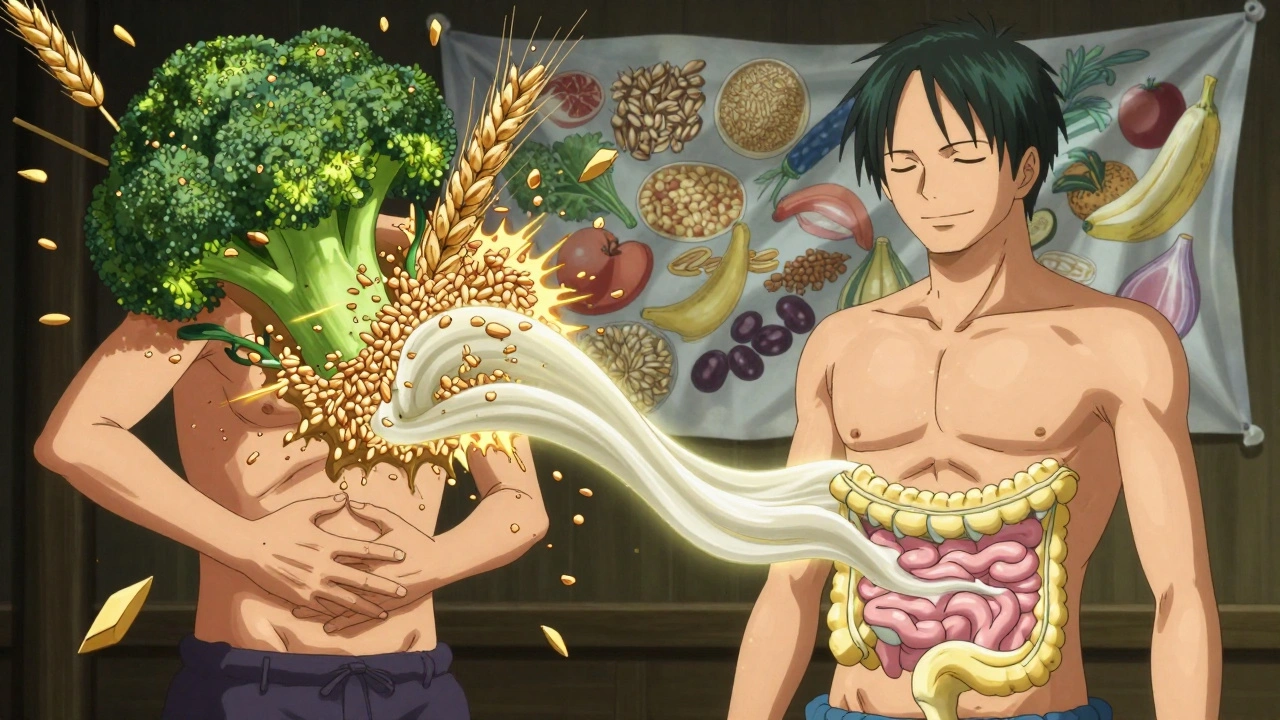
Here’s the thing: your gut doesn’t care about labels like ‘soluble’ or ‘insoluble.’ It just wants balance. The Mediterranean diet, backed by decades of research, gets it right. It serves up a mix-about three parts insoluble to one part soluble-from whole grains, legumes, fruits, nuts, and vegetables. That’s not an accident. That’s how nature designed it.
Together, they do more than just keep you regular. Soluble fiber lowers LDL cholesterol by 5-10% when you eat 5-10 grams daily. Insoluble fiber improves insulin sensitivity by 10-15%. One supports your heart, the other your metabolism. And both feed the good bacteria that keep your immune system sharp.
Most people get plenty of insoluble fiber from bread and cereal-but they’re missing soluble fiber. That’s why so many people still struggle with blood sugar swings, high cholesterol, or mood issues, even if they’re eating ‘fiber-rich’ foods. You can’t just eat bran flakes and call it a day. You need the gel-makers too: oats, beans, flax, apples, and chia.
How Much Do You Really Need?
The Institute of Medicine says women under 50 need 25 grams of total fiber daily. Men need 38. But here’s the kicker: the average American eats only about 15 grams. That’s half the target. And it’s not because they’re lazy-it’s because modern diets are stripped of whole plants.
But jumping from 15g to 30g overnight is a recipe for disaster. Bloating, gas, cramps-those aren’t side effects. They’re your body screaming for time. The trick? Add 5 grams per week. Start with one extra serving of oats or lentils. Then add a handful of almonds. Then an apple with the skin. Give your gut three to four weeks to adjust.
And don’t forget water. Every 25 grams of fiber needs at least 1.5 to 2 liters of water. Without it, fiber just turns into a brick in your colon. Drink water throughout the day-not just when you eat.
What About Supplements?
Psyllium husk, inulin, methylcellulose-they’re everywhere. And yes, they work. But they’re not better than food. In fact, they’re worse. Whole foods come with vitamins, antioxidants, polyphenols, and other compounds that fiber alone can’t replicate. A 2024 review in PMC made it clear: isolated fiber supplements can’t match the complexity of a bowl of lentils with carrots and tomatoes.
Supplements might help if you’re struggling to meet your needs, but they’re a Band-Aid, not a cure. If you’re taking fiber pills because you don’t eat vegetables, the real fix is eating vegetables.

Special Cases: IBS, IBD, and Diabetes
If you have IBS, soluble fiber is your friend. Oats, psyllium, and bananas often bring relief. A Reddit survey of 147 people with IBS found 68% felt better within two weeks of adding soluble fiber. But avoid raw broccoli, cabbage, and bran if you’re bloated.
If you have IBD (Crohn’s or colitis), it’s trickier. During a flare-up, stick to low-residue, low-insoluble-fiber foods: white rice, peeled potatoes, cooked carrots. Once you’re stable, slowly reintroduce whole grains and seeds. The Crohn’s & Colitis Foundation recommends keeping insoluble fiber under 15g during flares.
For diabetes, soluble fiber is non-negotiable. It’s the only type that directly slows sugar absorption. Pairing a meal with chia pudding or a bowl of lentil soup can cut blood sugar spikes by 15-20%. Insoluble fiber helps too-by improving insulin sensitivity-but soluble is the star.
Start Simple
You don’t need to overhaul your diet overnight. Try this:
- Swap white toast for whole grain with a spoonful of chia seeds.
- Add a banana or apple to your morning routine.
- Have lentil soup twice a week instead of chicken nuggets.
- Snack on almonds or carrots instead of crackers.
- Drink a glass of water with every meal.
Do that for a month, and you’ll notice changes-not just in your bathroom habits, but in your energy, your cravings, and even your mood. Fiber isn’t just about digestion. It’s about how your whole body talks to itself.
Can soluble fiber help with diarrhea?
Yes. Soluble fiber forms a gel that thickens loose stools, making them more formed and easier to pass. Foods like oats, bananas, and psyllium husk are often recommended for diarrhea-predominant IBS. Unlike insoluble fiber, which speeds things up, soluble fiber slows digestion and regulates consistency.
Does insoluble fiber cause bloating?
It can, especially if you increase intake too fast or don’t drink enough water. Insoluble fiber adds bulk without dissolving, so without adequate hydration, it can sit in the gut and cause gas and pressure. Start slow-add 5g of fiber per week-and drink at least 1.5 liters of water daily for every 25g of fiber.
Is psyllium husk soluble or insoluble?
Psyllium husk is almost entirely soluble fiber. It’s one of the most effective forms for lowering cholesterol, regulating blood sugar, and improving stool consistency. It’s often used in supplements like Metamucil and is well-tolerated by people with IBS when introduced gradually.
Should I take fiber supplements if I don’t eat enough vegetables?
Supplements can help fill gaps, but they’re not a replacement. Whole vegetables and legumes provide fiber plus antioxidants, phytonutrients, and minerals that supplements don’t. If you’re skipping plants, focus on adding them first-then use supplements only if you’re still falling short after a month of dietary changes.
Can fiber improve mental health?
Emerging research suggests yes. Soluble fiber is fermented into short-chain fatty acids like butyrate, which influence the gut-brain axis. Studies link higher fiber intake to reduced anxiety and improved mood, possibly by reducing inflammation and boosting neurotransmitter production. A 2023 study found 78% of participants reported better mental clarity after eight weeks of consistent fiber intake from whole foods.
What to Do Next
If you’ve been feeling off-whether it’s sluggish digestion, sugar crashes, or low energy-it might not be stress or lack of sleep. It might be fiber. Start tracking your intake for a week. Use a free app like Cronometer to see where you stand. Then pick one soluble fiber food and one insoluble fiber food to add daily. Drink water. Wait four weeks. Notice the difference. Your gut doesn’t need a miracle. It just needs consistency.





Comments
nikki yamashita
December 12, 2025 AT 05:39OMG YES this is everything I’ve been trying to tell my friends!! I switched to oats + chia every morning and my brain fog just… vanished?? Like, I didn’t even realize how tired I was until it was gone. 🙌
wendy b
December 12, 2025 AT 18:40Actually, most people don’t even know soluble fiber is fermented by *bacteroidetes* specifically - it’s not just ‘gut bacteria.’ You’re oversimplifying. And psyllium? It’s a synthetic derivative, not ‘natural.’
Adam Everitt
December 14, 2025 AT 02:13the gut is not a pipe, nor a broom, nor a garden… it’s a conversation. and fiber? it’s the silence between words. the pause that lets the body remember it’s alive.
Audrey Crothers
December 15, 2025 AT 10:21THIS!! I had constant bloating for years. Added 1 tbsp chia to yogurt every morning. 3 days later? No more panic-bathroom trips. Life changed. 💕
Stacy Foster
December 16, 2025 AT 18:09They’re hiding the truth - fiber supplements are pushed by Big Pharma to keep you dependent. Why do you think they don’t want you eating real food? They profit off your digestive misery.
Rob Purvis
December 17, 2025 AT 14:18Just to clarify - soluble fiber doesn’t just ‘trap’ sugars; it forms a viscous matrix that delays gastric emptying and modulates SGLT1 transporter activity. And yes, butyrate does upregulate tight junction proteins like occludin and claudin-3 - this is well-documented in Cell Host & Microbe 2023.
Laura Weemering
December 18, 2025 AT 08:18But… what if your microbiome is already destroyed? What if you’ve been on antibiotics since childhood? What if you’re just… broken? Do fiber recommendations even matter anymore?
Reshma Sinha
December 19, 2025 AT 07:50Insoluble fiber = colon highway. Soluble = gut repair crew. You need both. Like oxygen and water. Don’t just eat bran flakes and call it a diet. 🙄
Lawrence Armstrong
December 20, 2025 AT 12:25My 70-year-old mom eats 3 apples a day with skin + 2 tbsp flax. No meds. No colonoscopies. She’s 70. I’m 32 and eating ‘clean’ but still bloated. Maybe I’m just doing it wrong?
Donna Anderson
December 21, 2025 AT 11:02wait so… if i eat oatmeal and almonds and an apple… i dont need supplements?? i thought i had to buy that purple powder from amazon…
Robert Webb
December 21, 2025 AT 15:41It’s worth noting that the 3:1 insoluble-to-soluble ratio in the Mediterranean diet isn’t arbitrary - it mirrors the fiber composition of ancestral diets, which were rich in wild tubers, legumes, and unprocessed grains. Modern processing strips soluble fiber almost entirely, leaving us with inert bulk. That’s why we see skyrocketing rates of metabolic syndrome despite ‘high-fiber’ labels on cereal boxes. The solution isn’t more fiber - it’s more *whole* food.
And hydration isn’t just ‘drink water.’ It’s about electrolyte balance. Sodium and potassium are critical for fiber to swell properly. If you’re drinking 2L of water but eating a low-sodium diet, you might still get constipated. That’s why bone broth and pickled veggies help - they’re not just ‘ancient remedies,’ they’re osmotic regulators.
Also, timing matters. Eating fiber with fat slows transit time, which is great for blood sugar but bad if you’re constipated. Pairing fiber with caffeine - like coffee with oatmeal - can stimulate peristalsis. It’s not magic. It’s physiology.
And for those asking about IBD flares: yes, insoluble fiber can irritate. But so can low-fiber diets long-term. The key is *gradual reintroduction* with low-residue cooking methods: steaming, peeling, pureeing. One study showed that patients who reintroduced cooked carrots and peeled apples at 5g/day increments had 70% fewer relapses than those who went cold-turkey.
Finally - the gut-brain axis isn’t just about butyrate. It’s also about vagal tone. Fiber-fed microbiomes produce more GABA precursors. That’s why some people feel calmer. Not placebo. Neurochemistry. Your gut is literally talking to your amygdala.
Nathan Fatal
December 22, 2025 AT 19:22There’s a reason ancient cultures fermented grains and legumes - it pre-digests fiber and reduces anti-nutrients. Modern ‘fiber-rich’ foods are often raw and unprocessed, which is why so many people get bloated. Try soaking lentils overnight. Or sourdough bread. The microbiome doesn’t need more fiber - it needs more *accessible* fiber.
sandeep sanigarapu
December 23, 2025 AT 00:11Very good explanation. Fiber is not only for digestion. It is for peace of mind. Thank you.
Ashley Skipp
December 24, 2025 AT 21:47Just eat more vegetables and stop overthinking it
Levi Cooper
December 25, 2025 AT 21:03Why are we all obsessed with fiber? In America, we’ve turned nutrition into a cult. Back in my dad’s time, people just ate food - no labels, no science, no chia seeds. We survived. Maybe the problem isn’t fiber… it’s that we’ve forgotten how to eat.