
Compounding Pharmacies: Alternatives When Drugs Are Unavailable
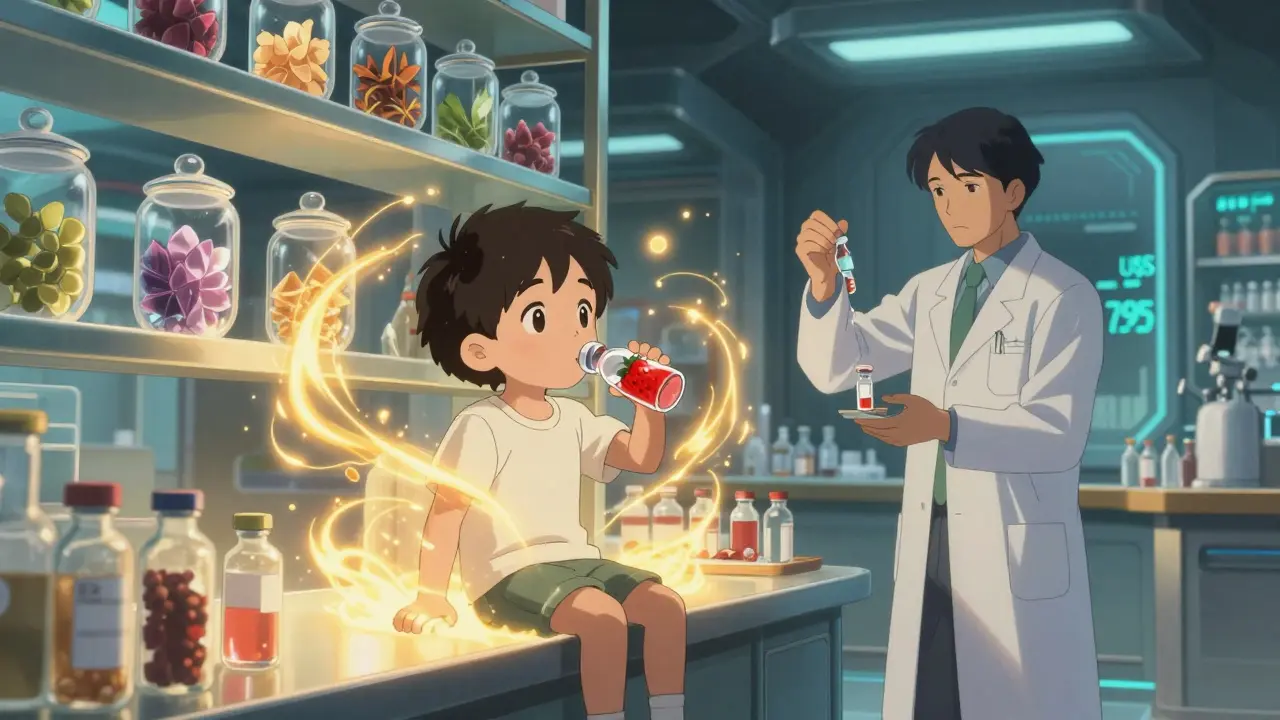
When a life-saving medication runs out and no replacement is available, what do you do? For many patients, the answer isn’t waiting for a new shipment or switching to a different drug-it’s finding a compounding pharmacy. These aren’t your average drugstores. They’re specialized labs where pharmacists build medications from scratch, tailored to individual needs when commercial options fail.
Why standard drugs aren’t always enough
Every year, between 300 and 400 drugs disappear from U.S. shelves due to manufacturing issues, supply chain problems, or low profitability. These aren’t rare cases. Think insulin, antibiotics, or even basic blood pressure pills. When this happens, patients are left scrambling. Some try to stretch their supply. Others switch to less effective alternatives. But for many, there’s a better path: compounding.Compounding pharmacies don’t just fill prescriptions. They solve problems. A child who can’t swallow pills? They can turn a tablet into a strawberry-flavored liquid. Someone allergic to dyes or lactose in their medication? They can strip out the irritants and rebuild the dose. Elderly patients with swallowing issues? A cream or gel can replace a pill. These aren’t theoretical fixes-they’re daily realities for thousands.
What compounding pharmacies actually do
Unlike retail pharmacies that distribute mass-produced drugs, compounding pharmacies work with raw ingredients. They mix, crush, dissolve, or blend them to create custom formulas. This means they can adjust:- Dosage strength-down to the exact milligram, even for tiny pediatric or geriatric doses
- Dosage form-turning a pill into a liquid, gel, lollipop, or transdermal patch
- Ingredients-removing allergens like gluten, dairy, artificial colors, or preservatives
- Combination-putting multiple drugs into one dose to simplify a complex regimen
For example, if a patient needs 15 mg of a medication that’s only sold in 20 mg or 5 mg tablets, a compounding pharmacist can precisely measure and blend the right amount. No cutting pills. No guessing. No wasted medication.
These pharmacies follow strict standards: USP <795> for non-sterile compounds (like creams or liquids) and USP <797> for sterile ones (like injections or IV solutions). Many also get accredited by the Pharmacy Compounding Accreditation Board (PCAB), which audits their processes, equipment, and cleanliness. Out of roughly 7,500 specialized compounding pharmacies in the U.S., only about 1,200 are PCAB-accredited-so checking this matters.
Who benefits most from compounding?
Not everyone needs it. But for certain groups, it’s life-changing:- Children: About 40% of kids can’t swallow pills. Compounding lets pharmacists turn bitter medicines into sweet, kid-friendly liquids or chewables. One study found 73% higher adherence when flavors like bubblegum were added.
- Elderly patients: Around 30% of seniors have trouble swallowing. Creams, gels, or sublingual troches (lozenges that dissolve under the tongue) make treatment possible.
- Allergy-sensitive patients: Up to 20% of people react to fillers or dyes in commercial drugs. Compounding removes these, allowing safe use of otherwise essential medications.
- Chronic condition patients: Hormone therapy, pain management, and dermatology treatments are among the top three uses. For example, a patient with estrogen sensitivity might get a custom transdermal cream instead of a pill that causes nausea.
One real case from Reddit: a man switching from oral finasteride (for hair loss) to a compounded topical version saw his side effects drop from 32% to just 8%. That’s not luck-it’s precision.

When compounding isn’t the answer
It’s tempting to think compounding pharmacies can replace any drug. But they can’t. They don’t make biologics-like insulin, vaccines, or monoclonal antibodies. They can’t replicate complex manufacturing processes used for drugs like chemotherapy agents or injectables that require sterile, large-scale production.Also, if a commercial version is available and safe, compounding shouldn’t be the first choice. The FDA and experts like Dr. Robert Smith from the National Community Pharmacists Association warn that about 15% of compounded prescriptions could have used FDA-approved drugs instead. That’s unnecessary risk. Compounding lacks the same pre-market testing. While most are safe, mistakes happen-especially if the pharmacy isn’t accredited.
Compounding is a bridge-not a replacement. It’s for when the standard option doesn’t work, not when it’s just inconvenient.
Cost and insurance: the hidden hurdle
One of the biggest complaints? Price. About 45% of patients pay out-of-pocket for compounded medications. Insurance often doesn’t cover them because they’re not FDA-approved. Even when covered, prior authorization can take days or weeks.Standard prescriptions? Only 15% of patients pay full price. Compounded ones? Often $50-$200 per fill, depending on complexity. That’s why many patients delay or skip them-even when they’re medically necessary.
Some pharmacies offer payment plans or work with specialty distributors to reduce costs. Others partner with patient advocacy groups to help navigate insurance. But it’s still a barrier. If cost is a concern, ask your pharmacist: is there a generic version? A different formulation? A less expensive compounding option?
How to get a compounded medication
It’s not as simple as walking into CVS. Here’s how it works:- Your doctor identifies a problem: “This drug isn’t working,” “My patient is allergic,” or “It’s unavailable.”
- Your doctor writes a prescription with specific instructions: dosage, form, ingredients to avoid.
- You take it to a compounding pharmacy-preferably one with PCAB accreditation.
- The pharmacist reviews the formula, checks ingredient availability, and confirms safety.
- The medication is made, tested (if sterile), and delivered in 24-72 hours.
Don’t just pick the cheapest pharmacy. Ask if they’re PCAB-accredited. Ask if they test stability and potency. Ask about their cleanroom standards. These aren’t just nice-to-haves-they’re critical.
The future of personalized medicine
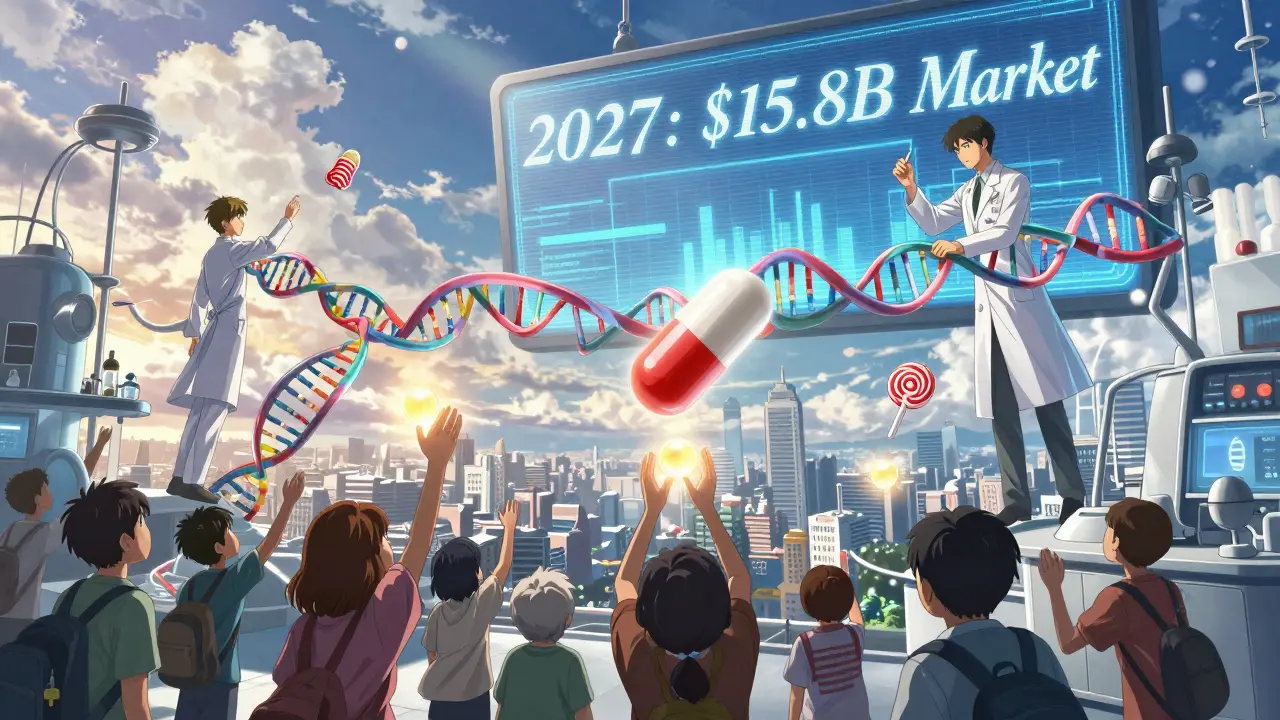
Compounding is growing fast. The U.S. market hit $11.2 billion in 2022 and is projected to hit $15.8 billion by 2027. Why? Because demand keeps rising. Drug shortages aren’t slowing down. Patient expectations for personalized care are. And technology is helping: digital formulation tools are cutting compounding errors by 37%. New stability tests are extending shelf life by up to 40%.Some pharmacies are even starting to use genetic testing to tailor doses. Imagine a pill that’s built around your DNA-not a one-size-fits-all approach. That’s not sci-fi. It’s already happening in 68% of compounding pharmacies.
Regulators are catching up too. The FDA updated its guidance in 2022 to clarify when compounding is acceptable during shortages. PCAB raised its standards in 2023. The system isn’t perfect-but it’s getting better.
Final thoughts
Compounding pharmacies aren’t magic. But when drugs vanish, they’re one of the few tools left that can actually help. They’re not for everyone. But for kids who gag on pills, seniors who can’t swallow, or anyone allergic to the fillers in their medicine-they’re essential.If you’re stuck because a drug is unavailable, don’t accept “there’s nothing we can do.” Talk to your doctor. Ask if a compounding pharmacy can help. Find one that’s accredited. Ask about cost and insurance. You might be surprised at what’s possible.
Are compounded medications safe?
Yes-when they’re made by accredited pharmacies following USP standards. Compounded drugs aren’t FDA-approved like mass-produced drugs, but they’re held to strict quality standards. PCAB-accredited pharmacies undergo regular audits for cleanliness, accuracy, and ingredient sourcing. Always choose a pharmacy with accreditation and ask for documentation on testing and sterility.
Can any pharmacy compound medications?
Technically, yes-but most don’t. Out of 56,000 community pharmacies in the U.S., only about 7,500 specialize in compounding, and only 1,200 are PCAB-accredited. Regular pharmacies may offer simple compounding like flavoring liquids, but complex or sterile preparations require specialized equipment and training. Don’t assume your local pharmacy can handle it.
How long does it take to get a compounded medication?
Typically 24 to 72 hours. Simple non-sterile formulas (like creams or liquids) can be ready in a day. Sterile compounds (injections, IVs) take longer due to extra testing and cleanroom protocols. This is slower than a standard prescription, which is often filled immediately. Plan ahead if you’re running low.
Why don’t insurance companies cover compounded drugs?
Because they’re not FDA-approved. Insurance plans typically only cover drugs that have gone through the full FDA approval process. Compounded medications are treated as custom-made, so they’re often excluded unless the prescriber submits strong medical justification. Some plans cover them case by case, but many require patients to pay out-of-pocket.
Can compounding pharmacies make any drug I need?
No. They can’t make biologics (like insulin, vaccines, or monoclonal antibodies), complex chemotherapy agents, or drugs that require large-scale sterile manufacturing. They also can’t replicate exact chemical structures of patented drugs without risking legal issues. Their strength is customization-not replication. If a drug is unavailable because it’s too complex to make, compounding won’t help.
Comments
Christina VanOsdol
February 25, 2026 AT 03:59This is literally life-changing for my kid who gagged on every pill. We switched to a strawberry-flavored liquid compounding version of his antibiotic, and suddenly he’s taking it without crying. I wish more doctors knew about this. 🙌
Emily Wolff
February 26, 2026 AT 09:09Compounding? More like pharmaceutical roulette.
Joseph Cantu
February 27, 2026 AT 02:33You think they're helping? Nah. Big Pharma lets drugs disappear on purpose so compounding pharmacies can charge $200 for what should cost $5. The FDA’s in bed with them. You’re being played. 🤡
Alfred Noble
February 28, 2026 AT 13:22I had a friend who got a compounded thyroid med after his insurance dropped the brand. Took him 3 weeks to get it, but it worked way better than the generic. Still, gotta pick a PCAB place - my cousin went to some sketchy shop and ended up with a batch that was way too strong. Scary stuff.
Khaya Street
March 1, 2026 AT 22:35Interesting read, but let’s be real - most people can’t afford this. You talk about $50-$200 per fill like it’s a coffee run. For many, that’s a week’s groceries. This isn’t innovation - it’s a luxury fix for a broken system.
Brooke Exley
March 2, 2026 AT 07:22Y’all need to stop acting like compounding is some secret weapon - it’s not. It’s a necessity. I’ve seen grandmas on 8 meds turn into 3 custom gels. No more swallowing 10 pills at 5am. No more vomiting from fillers. This isn’t ‘alternative medicine’ - it’s smart medicine. And if your doctor doesn’t know about it? Find a new one. 💪
Jacob Carthy
March 3, 2026 AT 00:10Why are we even talking about this? Just make drugs in the USA again. Stop outsourcing everything and then crying when it breaks. Compounding is a band-aid on a gunshot wound. We need factories, not pharmacies mixing stuff in back rooms.
Haley Gumm
March 4, 2026 AT 09:30I read this whole thing and I’m still confused. Is this legal? Who’s regulating it? Why isn’t this in the news more? Also, why do I feel like I just read a pharmaceutical ad?
Nick Hamby
March 5, 2026 AT 02:58There’s a deeper philosophical layer here, isn’t there? The shift from mass-produced, one-size-fits-all pharmaceuticals to hyper-personalized, patient-specific formulations reflects a fundamental evolution in medical ethics - from efficiency to individual dignity. We’re not just compounding drugs; we’re reasserting the patient’s right to be treated as a person, not a data point. The cost and regulatory barriers are tragic, yes - but they are not insurmountable. They are, in fact, moral challenges.
kirti juneja
March 7, 2026 AT 00:48In India, we’ve been doing this for ages - local pharmacists make custom mixes for kids and elderly all the time. No accreditation, no fancy labs, just skilled hands and trust. Maybe we don’t need PCAB - maybe we need more respect for local pharmacists. 🌏❤️
Lou Suito
March 8, 2026 AT 03:55You say 68% use genetic testing? Liar. Only 3% do. And even that’s exaggerated. I work in pharma logistics - I know the numbers. Also, USP standards? Half the compounding shops don’t even know what USP stands for. This article is propaganda.
Lisandra Lautert
March 9, 2026 AT 20:01I’m sorry, but if you’re relying on a pharmacy to mix your hormones, you’re already losing the game.
Matthew Brooker
March 11, 2026 AT 13:49To the person who said ‘you’re losing the game’ - chill. For a trans person on testosterone who can’t tolerate the fillers in the commercial version? This isn’t losing. This is surviving. I’ve been on a compounded T cream for 4 years. My labs are perfect. My mood is stable. My doctor says it’s better than the pill. So no, I’m not losing. I’m thriving. And so are thousands like me.