
Chemotherapy and Drug Interactions in Cancer Patients: What You Need to Know
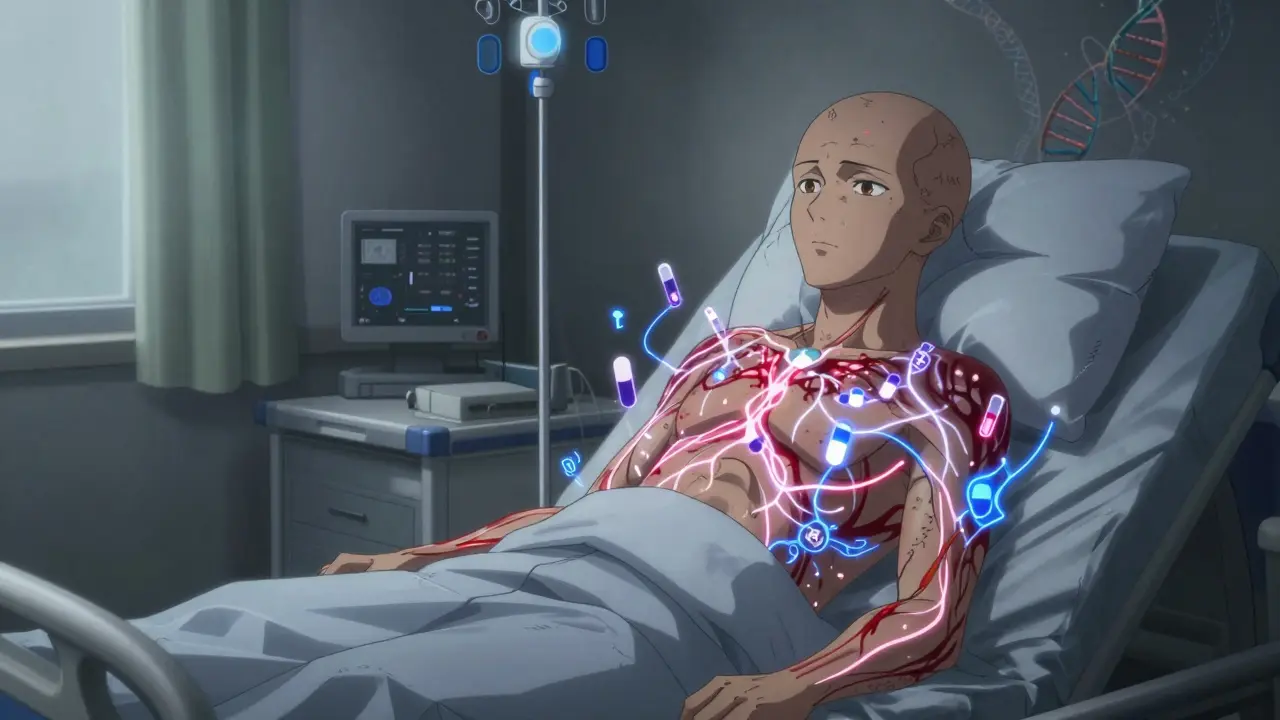
When someone is diagnosed with cancer, chemotherapy is often one of the first treatments discussed. It’s not new-it’s been around since the 1940s-but it’s still one of the most powerful tools doctors have. More than half of all cancer patients will get chemotherapy at some point. And while it can be life-saving, it’s also complex, especially when other medications are involved.
How Chemotherapy Works
Chemotherapy doesn’t just kill cancer cells-it targets any fast-dividing cell in the body. That’s why it works so well against aggressive cancers like leukemia or lymphoma, where cells multiply quickly. But it also hits hair follicles, bone marrow, and the lining of the gut, which is why side effects like hair loss, low blood counts, and nausea are so common.
There are over 100 different chemotherapy drugs, grouped into classes based on how they work. Anthracyclines like doxorubicin damage DNA directly but can harm the heart if used too much. Alkylating agents like cyclophosphamide cross-link DNA strands, stopping cells from copying themselves. Antimetabolites like methotrexate mimic building blocks of DNA, tricking cells into using them instead. And plant alkaloids like vincristine block cell division by messing with the tiny structures that pull chromosomes apart.
These drugs aren’t given randomly. They follow strict schedules-usually every 2 to 4 weeks-because the body needs time to recover. The idea is simple: each dose kills a fixed percentage of cancer cells. So even if a tumor is huge, one round might kill 90%, the next 90% of what’s left, and so on. That’s why combination therapy is standard. Using three or four drugs together, like in the BEP regimen for testicular cancer, improves survival more than any single drug alone.
Why Drug Interactions Matter
Most cancer patients aren’t taking just chemotherapy. They’re on pain meds, antibiotics, antidepressants, heart drugs, even supplements. And here’s the problem: many of these can change how chemotherapy works.
Some drugs block the liver enzymes that break down chemo agents. If you’re taking fluconazole (an antifungal) while on paclitaxel, your body might not clear the chemo fast enough. That leads to toxic buildup. On the flip side, rifampin (used for tuberculosis) speeds up liver metabolism, making chemo less effective. Even common OTC meds like St. John’s Wort can interfere.
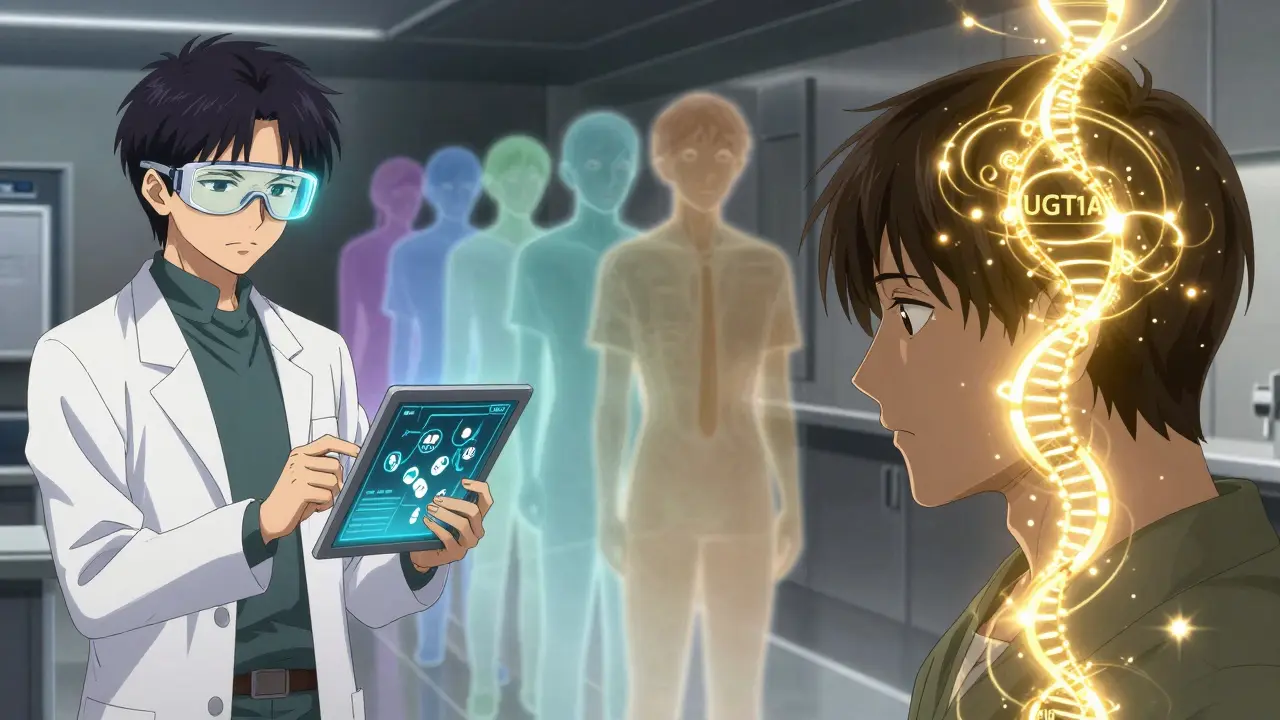
One of the most dangerous interactions involves irinotecan, a chemo drug used for colorectal cancer. It’s processed by an enzyme called UGT1A1. About 10% of people have a genetic variant that makes this enzyme slow. If they get the standard dose, they’re at high risk for severe, sometimes deadly, diarrhea and low white blood cells. Testing for this variant before starting treatment is now standard practice-but not always done.
Another big concern is with drugs that lower white blood cells. If you’re on chemotherapy and also take trimethoprim-sulfamethoxazole (an antibiotic), your risk of neutropenia jumps. That’s dangerous because low white cells mean your body can’t fight infection. One study found that patients on this combo were 3 times more likely to need hospitalization for fever than those on chemo alone.
And then there’s the issue of oral chemo. Drugs like capecitabine or temozolomide are taken at home. If a patient forgets a dose, takes it with grapefruit juice (which blocks metabolism), or starts a new supplement like milk thistle, the whole treatment plan can be thrown off. Non-adherence is a real problem-up to 30% of patients miss doses or take them incorrectly.
What Makes Chemotherapy Different from Other Treatments
Compared to radiation, which targets one area, chemo works everywhere. That’s why it’s essential for cancers that have spread. But it’s not as precise as targeted therapies or immunotherapies. Those newer treatments attack specific proteins on cancer cells, leaving healthy tissue alone. Chemo? It’s a shotgun blast.
That’s not always bad. In fact, for some cancers, chemo still wins. In metastatic triple-negative breast cancer, combination chemo gets a 65% response rate, while immunotherapy alone only hits 42%. The trade-off? Chemo causes serious side effects in 58% of patients; immunotherapy causes them in 32%. For many, the numbers still favor chemo.
But in slow-growing cancers like prostate or ovarian, chemo often doesn’t help much. That’s where newer drugs shine. Still, in early-stage cancers-like stage II or III breast cancer-chemo remains the gold standard. NCCN guidelines list anthracycline-taxane combinations as the highest-level recommendation because they cut recurrence risk by 30-40%.
Real-World Challenges Patients Face
It’s easy to talk about drug classes and mechanisms. But for patients, it’s about fatigue, nausea, neuropathy, and fear.
Studies show 68% of patients feel moderate to severe fatigue during chemo. Even with anti-nausea drugs, over half still throw up. And for those on taxanes like paclitaxel, 41% develop nerve damage-numbness, tingling, burning in hands and feet. Sometimes it’s temporary. Sometimes it lasts years.
And it’s not just physical. A 2023 survey found that 44% of patients had treatment delayed because their white blood cell count dropped too low. Black patients were 1.7 times more likely to face delays than white patients. That’s not just a medical issue-it’s a systemic one.
But here’s the surprising part: 76% of patients said they’d go through chemo again. Why? Because it worked. One woman on a cancer forum wrote, “My AC-T chemo saved my life. The 16 weeks were hell, but I’m alive.”
How Care Teams Keep Patients Safe
Administering chemo isn’t just about giving a drug. It’s a high-stakes operation.
Hospitals require board-certified oncology pharmacists to double-check every prescription. In the U.S., 98% of cancer centers use them. Nurses need 120 to 160 hours of training before they can give chemo. And every facility must have emergency plans ready-for allergic reactions, for tumor lysis syndrome (where dying cancer cells overload the kidneys), for extravasation (when the drug leaks into tissue and burns it).
Electronic order systems with built-in safety checks are now standard in major cancer centers. They catch wrong doses, drug interactions, and allergies before the patient even gets the IV. But not all clinics have them. Community centers still lag behind, creating gaps in care.
And now, there’s a new focus: pharmacogenomics. Testing your genes before chemo isn’t optional anymore. If you’re getting irinotecan, they test UGT1A1. If you’re on tamoxifen, they check CYP2D6. These tests don’t just prevent side effects-they make treatment more effective.
The Future: Smarter, Safer Chemo
Chemotherapy isn’t disappearing. But it’s changing.
Antibody-drug conjugates like sacituzumab govitecan are a breakthrough. They deliver chemo directly to cancer cells, like a guided missile. In triple-negative breast cancer, they work where traditional chemo failed-and with far fewer side effects.
Another innovation? Using circulating tumor DNA to decide how long chemo lasts. A 2023 trial showed that patients with stage II colon cancer who stopped chemo early based on DNA tests had the same survival rates as those who finished full treatment-but avoided unnecessary toxicity.
Nanoparticles are in the pipeline. These tiny carriers can deliver chemo straight to tumors, reducing exposure to healthy tissue by up to 70%. If they pan out, they could make chemo tolerable for more people.
And the big shift? Chemo is no longer used alone. Over 85% of new chemo regimens in clinical trials now combine it with targeted drugs or immunotherapy. It’s not about choosing one or the other anymore. It’s about layering them-chemo to shrink tumors fast, then precision drugs to finish the job.
What You Should Do
If you or someone you know is on chemotherapy:
- Make a full list of every medication, supplement, and OTC drug you take-including vitamins and herbal teas.
- Bring that list to every appointment. Don’t assume your oncologist knows.
- Ask: “Could this interact with my chemo?” Even if it’s something you’ve taken for years.
- Know your genetic test results. If you had a gene test before starting treatment, ask for a copy.
- Report side effects early. Don’t wait until you’re in the ER.
- Ask about palliative care. It’s not just for end-of-life. Studies show it improves quality of life and even survival when started early.
Chemotherapy is tough. But it’s also one of the most effective tools we have. With the right care, the right checks, and the right support, it can still change lives.
Can chemotherapy interact with over-the-counter supplements?
Yes, absolutely. Supplements like St. John’s Wort, milk thistle, echinacea, and even high-dose vitamin C can interfere with how chemotherapy is processed by the liver. St. John’s Wort, for example, speeds up the breakdown of many chemo drugs, making them less effective. Milk thistle can block the same liver enzymes that clear certain drugs, leading to dangerous buildup. Always tell your oncology team about every supplement you take-even if you think it’s "natural" or "safe."
Why do some people need genetic testing before chemotherapy?
Some chemotherapy drugs are broken down by specific enzymes in the liver, and people’s genes affect how well those enzymes work. For example, irinotecan is processed by UGT1A1. If you have a variant that makes this enzyme slow, you’re at high risk for life-threatening diarrhea and low white blood cells. Testing before treatment lets doctors adjust the dose to keep you safe. Similarly, tamoxifen needs CYP2D6 to become active. If you’re a poor metabolizer, it won’t work well. Genetic testing isn’t optional anymore for these drugs-it’s standard care.
Can chemotherapy be taken orally, and are there risks?
Yes, many chemo drugs are now pills-like capecitabine, temozolomide, and eribulin. But oral chemo comes with unique risks. Patients often forget doses, take them with food that interferes (like grapefruit), or stop because of side effects. Studies show 20-30% of patients don’t take oral chemo correctly. That can lead to treatment failure or unexpected toxicity. That’s why pharmacists now provide detailed counseling, pill organizers, and follow-up calls to ensure adherence.
Do chemotherapy drugs interact with antibiotics?
Yes, and it’s serious. Antibiotics like trimethoprim-sulfamethoxazole and ciprofloxacin can increase the risk of bone marrow suppression when taken with chemo. This means your white blood cell count can drop dangerously low, leading to infection. Other antibiotics, like rifampin, can make chemo less effective by speeding up liver metabolism. Always tell your oncologist if you’re prescribed an antibiotic-even for a simple infection.
Why is chemotherapy still used when newer treatments exist?
Newer drugs like targeted therapies and immunotherapies are powerful, but they don’t work for every cancer type or every patient. Chemotherapy remains the most effective first-line treatment for many cancers-especially aggressive ones like acute leukemia, lymphoma, and early-stage breast cancer. In fact, combination chemo still achieves higher response rates than immunotherapy alone in cancers like triple-negative breast cancer. It’s not about replacing chemo-it’s about using it smarter, with better support and in combination with newer tools.
What should I do if I miss a dose of oral chemotherapy?
Don’t double up. If you miss a dose, call your oncology team immediately. Some drugs can be taken late with no problem. Others need to be skipped entirely to avoid toxicity. The rules vary by drug. Never guess. Your pharmacy or oncology nurse will give you specific instructions based on the medication and how much time has passed. Always keep their contact info handy.
Comments
Simon Critchley
February 8, 2026 AT 23:30Let’s be real-chemo is the OG nuclear option. I’ve seen guys on paclitaxel look like zombies who just lost a fight with a lawnmower. But damn, it works. That BEP regimen? Pure surgical strike on testicular cancer. I mean, if you’re gonna go full shotgun to the tumor, at least make sure the pellets are calibrated. Pharma nerds love this shit because it’s a fucking biochemical ballet. 🤓💥
Joseph Charles Colin
February 9, 2026 AT 02:23UGT1A1 testing isn’t optional-it’s the bare minimum. I’ve seen patients get 100% of the standard irinotecan dose because their chart said ‘no prior history.’ Two days later, they’re in ICU with grade 4 neutropenia and diarrhea that turned their rectum into a slip ‘n slide. Genetic screening isn’t ‘nice to have.’ It’s the difference between survival and a coroner’s report. Stop treating oncology like it’s a game of roulette.
Brandon Osborne
February 9, 2026 AT 20:07You people are all just too nice. Nobody’s telling the truth-chemo is torture dressed up as science. They tell you it’s ‘life-saving’ but never mention the 6 months of numb feet, the 12-hour vomiting marathons, or the fact that your kid has to learn what ‘neutropenic fever’ means at age 7. And don’t even get me started on the $300 pill you forgot to take because you were too tired to care. This isn’t medicine. It’s a survival lottery with rigged odds.
Chelsea Cook
February 10, 2026 AT 14:04Oh wow, so now we’re pretending St. John’s Wort is the villain? Meanwhile, Big Pharma is quietly lobbying to keep herbal supplements off the radar because they don’t want to admit their drugs are fragile as wet toilet paper. I’ve seen patients on tamoxifen take turmeric for inflammation-and suddenly their estrogen levels go haywire. But hey, let’s blame the tea. 🙃
John McDonald
February 10, 2026 AT 22:24I work in oncology nursing. We had a guy on capecitabine who took it with grapefruit juice every morning for 3 weeks. No one asked. He ended up with a 3-day hospital stay for toxicity. We don’t need more studies-we need better handholding. Every patient gets a pill organizer, a video demo, and a follow-up call. Not ‘maybe next week.’ RIGHT NOW. And yes, I’m yelling. Because lives are on the line.
John Watts
February 11, 2026 AT 06:58Just wanted to say-I beat stage III breast cancer with AC-T. Yeah, it sucked. Hair gone. Nails cracked. Felt like my bones were filled with gravel. But I’m alive. My daughter’s 10 now. She still draws me as a superhero with a chemo IV cape. So yeah, it’s brutal. But if you’re reading this and scared? You’re not alone. And it’s worth it. We’re still here.
Tom Forwood
February 12, 2026 AT 09:33bro i just had my aunt go through this and holy cow the real issue is not the drugs-it’s the system. She got delayed because her white count dropped and they couldn’t get an appointment for 3 weeks. Meanwhile, her neighbor, white guy in his 50s, got seen same day. And don’t get me started on the pharmacy that gave her the wrong dose of temozolomide because ‘it looked similar.’ This ain’t rocket science. It’s just… broken. And the docs? They’re overworked. We need more hands, not more memes.
Andrew Jackson
February 12, 2026 AT 10:24It is a moral failure of Western medicine that we still rely on blunt-force cytotoxic agents to treat cancer. We have the technology to engineer precision therapeutics-yet we persist with a 1940s paradigm rooted in brute-force cellular annihilation. This is not progress. It is institutional inertia masquerading as science. The fact that we permit oral chemo to be administered without direct supervision is a dereliction of duty. We must elevate the standard. We must demand more than survival. We must demand dignity.
Chima Ifeanyi
February 13, 2026 AT 10:53Let’s not pretend this is about science. Chemo is a profit engine. The drugs are expensive. The side effects create follow-up bills. The ‘new’ ADCs? Same thing-$500k/year with 6-month survival bump. Meanwhile, in Nigeria, people die because they can’t even get a basic CBC. This isn’t medicine. It’s capitalism with a stethoscope. And your ‘pharmacogenomics’? That’s just a fancy way to charge extra for a blood test.
Frank Baumann
February 14, 2026 AT 13:54I’ve been on chemo for 4 years. I’ve had 12 different regimens. I’ve been hospitalized 7 times. I’ve lost my job, my marriage, and half my hair. But here’s the truth no one says: I don’t regret it. Not once. Because every time I thought I was done, I woke up and my daughter was still there. I still smell her shampoo. I still hear her laugh. And yeah, the neuropathy? Still there. The fatigue? Always. But I’m here. And if I can make it through this, you can too. Don’t give up. Not today. Not ever.
Kathryn Lenn
February 14, 2026 AT 20:09Who funded this article? Pharma? Because it reads like a 30-second commercial for chemo. ‘It’s still the gold standard’-sure, if you’re okay with 58% of patients being wrecked. What about the 20% who die from complications? What about the ones who get secondary cancers from the chemo? They don’t talk about that. They just say ‘it works.’ Yeah. It works. Like a bomb works. And we’re supposed to be grateful?
Chelsea Deflyss
February 15, 2026 AT 10:30my doc said i need genetic testing for tamoxifen but i dont even know what my blood type is lmao
Jessica Klaar
February 16, 2026 AT 14:28My mom’s on capecitabine. She forgets doses. She takes them with orange juice because she thinks it helps. I had to print out a color-coded chart with pictures of the pill, the time, and a little sun for morning and moon for night. She cries when she misses one. I cried too. We need more than pamphlets. We need someone to sit with them. To call. To check in. To say, ‘It’s okay, we’ll reset.’ It’s not just about the drug-it’s about the person holding the pill.
Angie Datuin
February 17, 2026 AT 17:44My brother died from a chemo interaction. He took cipro for a UTI. No one asked him about his chemo. He got neutropenic sepsis. They didn’t even test his white count until he was in cardiac arrest. I’m not mad. I’m just… tired. If you’re reading this, please. Tell your doctor everything. Even the tea. Even the fish oil. Even the ‘just one’ supplement. It matters. It really does.