
Hospital Formulary Economics: How Institutions Choose Generics to Cut Costs Without Compromising Care

When a hospital decides to switch from a brand-name drug to a generic, it’s not just a simple price swap. Behind that decision is a complex, data-driven process that balances clinical safety, patient outcomes, and hard-dollar savings. In 2025, generics make up 89% of all hospital drug purchases by volume-but only 28% of total spending. That gap is the engine of hospital formulary economics. And it’s not about picking the cheapest option. It’s about picking the right one.
What Is a Hospital Formulary, Really?
A hospital formulary isn’t just a list of drugs. It’s a living, breathing system managed by a Pharmacy and Therapeutics (P&T) committee that meets monthly or quarterly to review which medications are approved for use. Think of it as the hospital’s internal drug rulebook. It’s not about what’s on the market-it’s about what’s safe, effective, and cost-smart in this hospital, for these patients. The modern formulary evolved from the 1950s, when the American Society of Health-System Pharmacists (ASHP) began standardizing how hospitals selected drugs. Today, most hospitals use a closed or partially closed model, meaning only approved drugs are stocked. About 78% of academic medical centers operate this way, compared to just 42% of commercial insurers. Why? Because hospitals control the entire medication journey-from prescription to IV bag to bedside. That gives them more power to enforce guidelines.How Generics Get Into the Formulary
Getting a generic approved isn’t as simple as showing an FDA approval letter. P&T committees demand proof that the generic isn’t just chemically identical-it’s clinically interchangeable. That means:- It delivers the same active ingredient at the same rate and amount as the brand
- It performs the same way in real-world hospital settings
- It doesn’t cause unexpected side effects or monitoring issues
- Efficacy-Does it work as well?
- Safety-Are there hidden risks in ICU or oncology settings?
- Cost-Not just list price, but net cost after rebates and service agreements
Tiered Formularies: The Hidden Architecture
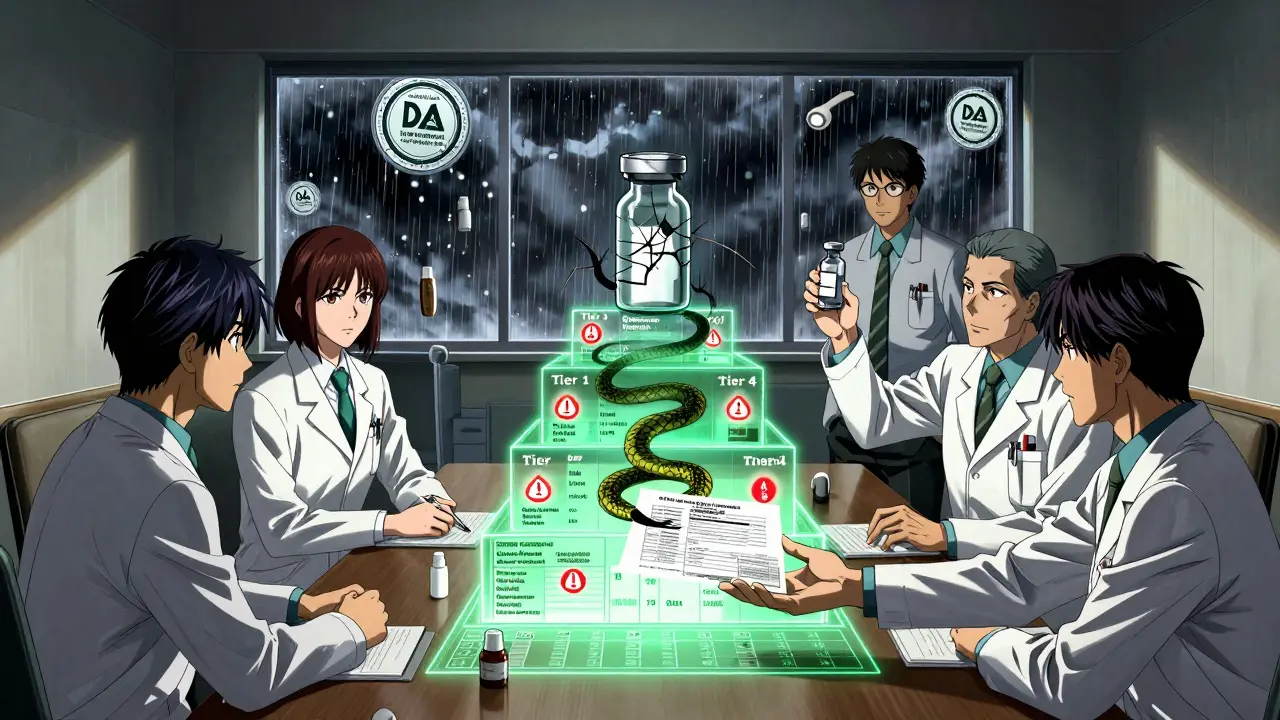
Most hospitals use a tiered system to guide prescribing. Here’s how it typically breaks down:| Tier | Drug Type | Cost to Patient | Prescribing Restrictions |
|---|---|---|---|
| Tier 1 | Preferred generics | Lowest copay | None-first-line choice |
| Tier 2 | Non-preferred generics or preferred brands | Moderate copay | May require prior authorization |
| Tier 3 | Non-preferred brands | Higher copay | Step therapy often required |
| Tier 4-5 | Specialty drugs | Coinsurance (e.g., 30-50%) | Strict prior auth, often only for specific conditions |
Why Hospitals Can’t Just Copy Retail Formularies
Medicare Part D plans must include at least two drugs in each of 57 therapeutic categories. Hospitals don’t have that requirement. They can-and often do-carry just one generic per class. That’s because hospitals manage drugs differently. In a retail pharmacy, a patient might forget to take their pill. In a hospital, a nurse administers it. There’s no concern about storage, expiration, or adherence. That control allows hospitals to use powerful tools:- Step therapy-Require a cheaper generic before approving a brand
- Quantity limits-Only allow 30 tablets per month, not 90
- Prior authorization-Require clinical justification before dispensing
The Hidden Costs of Cheap Generics
The biggest myth is that generics are always cheaper. Sometimes, they’re not. Supply chain disruptions hit hospitals hard. In Q3 2023, 84% of hospital pharmacists reported at least one critical generic shortage. When a Tier 1 generic is unavailable, hospitals are forced to buy non-formulary alternatives-often at 3 to 5 times the price. And then there’s the rebate trap. Manufacturers now offer rebates based on volume, formulary placement, or exclusive contracts. A drug might be listed at $10 per tablet, but with a $7 rebate, the net cost is $3. But if another generic offers a $9 rebate, it might win the contract-even if it’s less stable or harder to dose. The ASHP’s 2021 white paper warned that this “rebate-driven formulary” model risks clinical decisions being made by finance teams, not clinicians.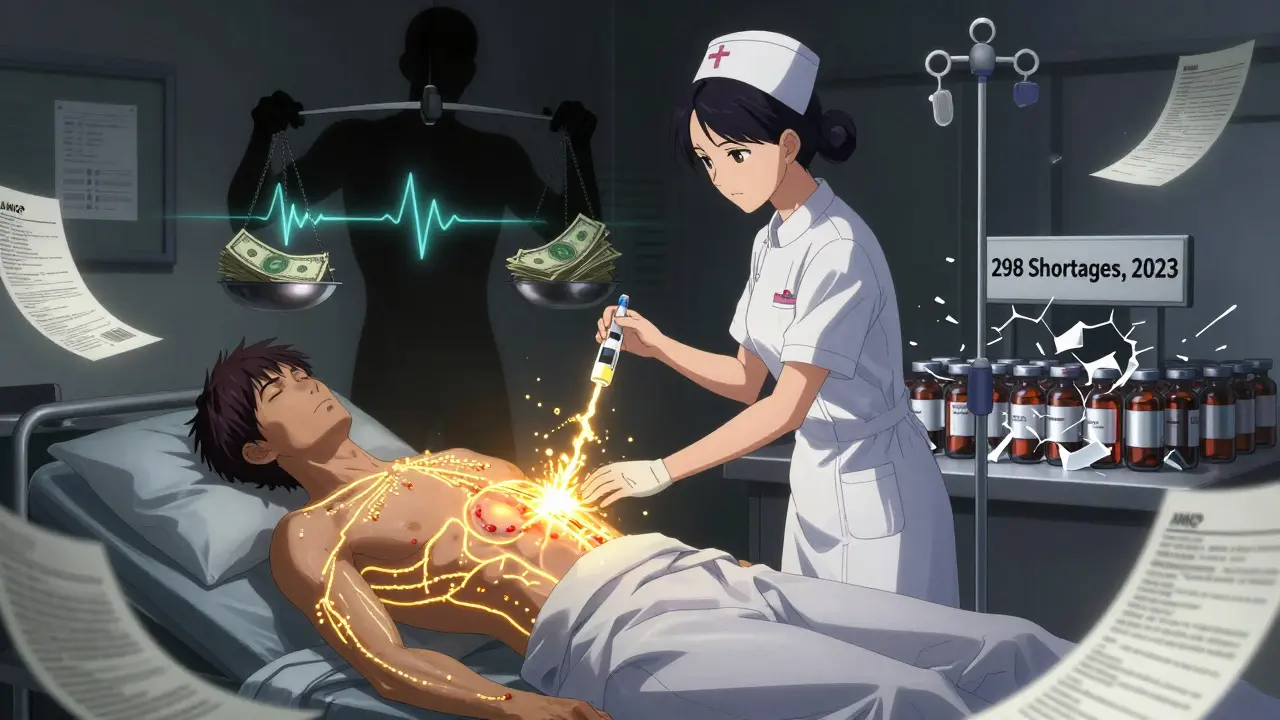
What Makes a Hospital Formulary Successful?
Successful formularies aren’t built by accident. They require:- At least 50% clinical pharmacists on the P&T committee
- Quarterly reviews of new generics within 90 days of FDA approval
- Formal AMCP dossiers-92% of academic centers now require these detailed submissions with clinical studies, pharmacology, and cost analyses
- Integration with EHRs-Only 37% of hospitals have automated alerts to guide prescribing
The Future: Transparency, Complexity, and Pharmacogenomics
Two big changes are coming: First, the 2023 Consolidated Appropriations Act requires full transparency in generic pricing by January 2025. Hospitals will finally see what rebates manufacturers are paying-something that’s been hidden for years. This could force formularies to shift from rebate-based to value-based decisions. Second, the FDA’s GDUFA III program is investing $4.3 million annually to speed up approval of complex generics. That means more injectables, inhalers, and topical products will enter formularies by 2026. And then there’s pharmacogenomics. In 2023, 28% of academic hospitals began using genetic testing data when choosing generics for drugs with narrow therapeutic indices-like warfarin or clopidogrel. If a patient has a gene variant that slows drug metabolism, a standard generic might be dangerous. That’s not a cost issue. It’s a safety issue.Final Reality Check
Hospital formulary economics isn’t about cutting costs at all costs. It’s about smart, evidence-based decisions that protect patients while using taxpayer and insurance dollars responsibly. The goal isn’t to use the cheapest generic-it’s to use the right generic. When done well, formularies save millions without sacrificing outcomes. When done poorly, they create hidden risks-drug shortages, monitoring burdens, and clinical errors that cost far more than the original brand. The best hospitals don’t just buy low. They think deeply. They monitor closely. And they never let a rebate override a patient’s safety.Are all generic drugs the same?
No. While all generics must meet FDA standards for bioequivalence, they can differ in inactive ingredients, manufacturing processes, and delivery systems. For simple oral pills, these differences rarely matter. But for complex generics-like inhalers, injectables, or extended-release tablets-small variations can affect how the drug is absorbed or delivered. Hospitals often test multiple generic versions before selecting one for their formulary.
Why do hospitals prefer closed formularies?
Closed formularies give hospitals control over drug use. By limiting options to approved medications, they reduce waste, prevent inappropriate prescribing, and make it easier to monitor outcomes and manage costs. Open formularies, common in retail, allow more choice but offer less control. Hospitals prioritize safety and efficiency over patient choice because medications are administered under direct supervision.
Can a hospital use a generic that’s not on the formulary?
Yes, but only in special cases. If a patient has an allergy, intolerance, or rare condition, clinicians can request a non-formulary drug through prior authorization. But these exceptions are tracked and reviewed. Overuse of non-formulary drugs triggers audits and can lead to policy changes. Hospitals aim to keep non-formulary use below 5% of total prescriptions.
How do rebates affect generic selection?
Rebates can distort decision-making. A generic with a lower list price might lose out to one with a higher rebate, even if it’s less stable or harder to use. Hospitals are starting to demand net cost data-what they actually pay after rebates and service fees-not just the sticker price. The 2025 transparency rules will force more honest comparisons.
Why are generic shortages a big deal for hospitals?
When a Tier 1 generic runs out, hospitals must turn to more expensive alternatives. In 2023, there were 298 active generic shortages-the highest ever. For drugs like phenytoin, insulin, or antibiotics, delays can be life-threatening. Hospitals now maintain emergency stockpiles and work with alternate suppliers, but these backups cost 2-5 times more. Shortages make cost-saving goals harder to meet.
What role do pharmacists play in formulary decisions?
Pharmacists are the backbone. At least half of every P&T committee must be clinical pharmacists. They review clinical data, interpret bioequivalence studies, assess supply chain risks, and calculate true net costs. They’re the ones who spot when a generic looks good on paper but causes real-world problems-like increased lab monitoring or dosing errors. Without them, formularies become financial tools, not clinical ones.
Looking ahead, the hospitals that thrive will be the ones that treat formulary economics as a clinical science-not just a procurement task. The numbers matter. But the patients always come first.





Comments
Matt Davies
December 19, 2025 AT 00:54This is the kind of deep-dive stuff that makes me actually excited about hospital admin. I used to think formularies were just bean counters playing monopoly with drug prices, but wow - it’s like a high-stakes chess game where every move affects someone’s life. The bit about inhalers and injectables? Mind blown. Not all generics are created equal, and it’s wild that most patients have no clue how much nuance goes into picking their meds. Kudos to the pharmacists pulling this off like clinical ninjas.
Ashley Bliss
December 19, 2025 AT 20:05Let’s be real - this isn’t about patient care. It’s about corporations turning healthcare into a spreadsheet game where the only metric that matters is net profit after rebates. They call it 'smart decision-making,' but it’s just capitalism in a lab coat. When a finance guy picks a drug because it gives him a 9% rebate, and a patient ends up in the ICU because the generic’s dissolution rate is off by 0.3% - that’s not economics. That’s moral failure. And don’t give me that 'patient safety first' lip service. If safety came first, we wouldn’t need 18-page dossiers just to swap a pill.
Dev Sawner
December 20, 2025 AT 21:58It is imperative to note that the statistical framework underpinning the formulary selection process is rigorously validated by the American Society of Health-System Pharmacists (ASHP) and the FDA’s GDUFA III guidelines. The assertion that rebates compromise clinical integrity is not substantiated by empirical data; rather, net cost analysis, when properly calibrated, enhances fiscal responsibility without compromising therapeutic outcomes. The 68% survey figure regarding therapeutic equivalence assessment challenges reflects insufficient training, not systemic flaw. Institutional governance must prioritize pharmacoeconomic rigor over anecdotal narratives.
Moses Odumbe
December 22, 2025 AT 20:06Bro. The fact that hospitals can’t just copy retail formularies is wild 😳. Like, imagine if your local CVS had to decide if your blood pressure med would work the same way in a 72-hour ICU marathon. 🤯 Pharmacists are the real MVPs here. And that 23.7% cost cut at Mayo? That’s not magic - that’s discipline. Also, rebates are a scam 🤡. Why does the drug that costs $10 but has a $9 rebate win over the one that’s $8 with no rebate? Someone’s getting rich while nurses do extra lab checks. #PharmaGreed
Meenakshi Jaiswal
December 23, 2025 AT 00:11As someone who’s worked in hospital pharmacy for 15 years, I can tell you - this post nails it. The real hero isn’t the algorithm or the rebate contract. It’s the clinical pharmacist who stays late to cross-check bioequivalence studies while the rest of the team is at dinner. I’ve seen generics cause INR spikes, IV precipitates, even allergic reactions from inactive ingredients nobody talks about. That’s why we test. That’s why we monitor. That’s why we fight for 50% clinical staff on P&T committees. It’s not about saving money. It’s about saving people. And yes - we’re tired. But we’re still here.
bhushan telavane
December 24, 2025 AT 18:08In India, we don’t have this luxury. Our hospitals use generics because they have no choice - not because of formularies, but because the government caps prices. Sometimes, the same generic from two different factories behaves differently. We don’t have EHR alerts or AMCP dossiers. We have nurses who memorize which brand doesn’t cause dizziness. Maybe the US system is over-engineered - or maybe we’re just surviving.
Mahammad Muradov
December 26, 2025 AT 12:46The assertion that hospital formularies prioritize patient safety over cost is demonstrably false. The prevalence of rebate-driven selection, coupled with the documented increase in monitoring burden following generic substitution, confirms that financial incentives override clinical judgment. The cited 18.3% cost reduction at Cleveland Clinic is irrelevant if it results in increased adverse event reporting. The data does not support the conclusion that 'the right generic' is being selected - only that the cheapest one is being masked as the best one.
Connie Zehner
December 27, 2025 AT 14:32Okay but can we talk about how the FDA approves these generics like they’re just… different colored M&Ms? 🤔 I had a friend who went into cardiac arrest because the generic metoprolol dissolved too slow - they didn’t even test it in real ICU patients! And now we’re supposed to trust that the same company making the cheap version also knows how to make it safe? 😭 Nurses are overworked, patients are scared, and the whole system is built on trust in a system that’s been gamed by pharma lobbyists. I’m crying. I’m so angry. Someone needs to burn it all down. 🔥
holly Sinclair
December 29, 2025 AT 06:08What fascinates me is how this entire system is a microcosm of our broader societal tension between efficiency and humanity. We’ve optimized everything - procurement, logistics, data tracking - but at what cost to the human element? The P&T committee is meant to be a sanctuary of clinical wisdom, yet it’s increasingly pressured by financial metrics, supply chain chaos, and opaque rebate structures. Is it possible to design a system that honors both the science of pharmacology and the dignity of the patient? Or have we already sacrificed the latter on the altar of fiscal pragmatism? And if so… who gets to decide what 'pragmatic' means? Is it the CFO? The pharmacist? The patient who can’t afford the co-pay? Or the manufacturer who owns the rebate? These aren’t policy questions. They’re existential ones.