
Generic Drugs: What They Are and How They Work
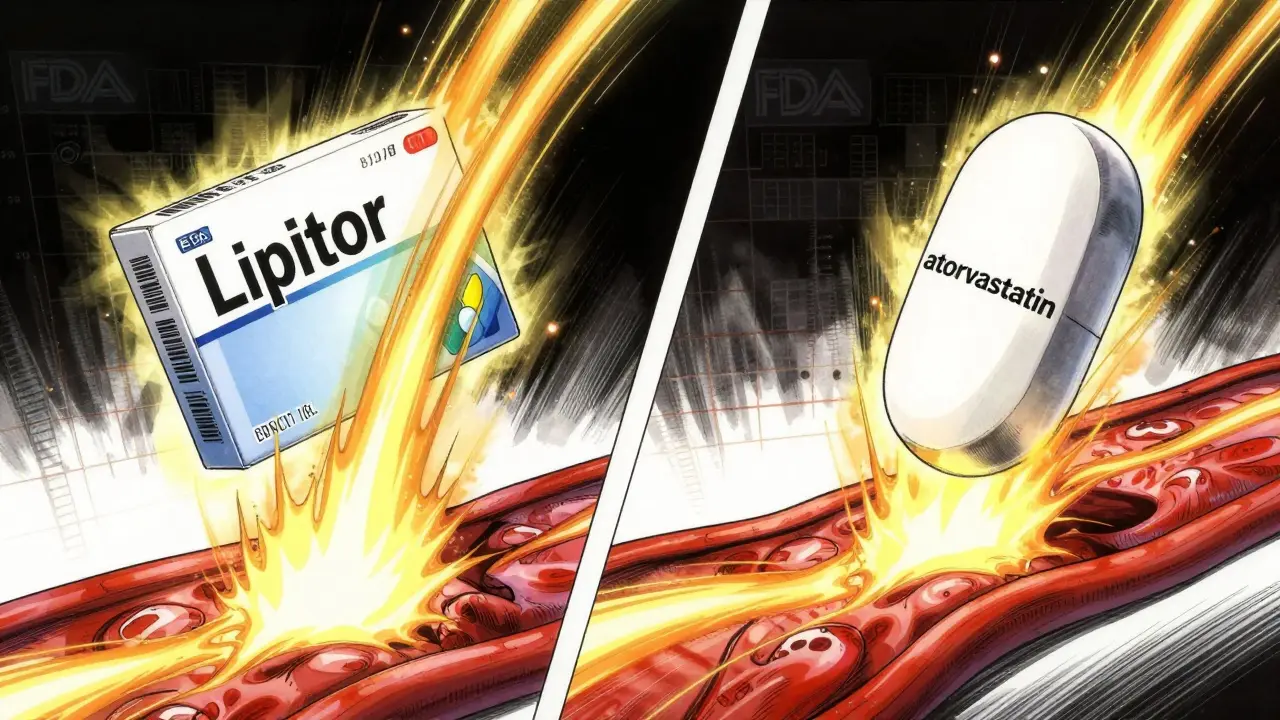
When you pick up a prescription, you might see two names on the label: one you recognize, like Lipitor , and another you don’t, like atorvastatin . The second one is a generic drug. It’s not a cheaper copy. It’s not a lower-quality version. It’s the same medicine, approved by the same agency, and held to the exact same standards.
What Exactly Is a Generic Drug?
A generic drug is a medicine that contains the same active ingredient as a brand-name drug, in the same strength, dosage form, and route of administration. It works the same way in your body. It treats the same condition. It has the same risks and benefits. The only differences are in the name, the color, the shape, and the price.
The U.S. Food and Drug Administration (FDA) defines it clearly: a generic drug must be bioequivalent to the brand-name version. That means it delivers the same amount of active ingredient into your bloodstream at the same rate. If you take 10 mg of generic atorvastatin, your body gets the same result as if you took 10 mg of Lipitor.
This isn’t guesswork. Before a generic drug can be sold, the manufacturer must prove it meets strict scientific standards. They don’t have to repeat the original clinical trials that cost billions. Instead, they run bioequivalence studies - usually with 24 to 36 healthy volunteers - to show that the drug behaves the same way in the body. The FDA requires that the concentration of the drug in the blood falls within 80% to 125% of the brand-name drug’s levels. That’s a tight range, and it’s designed to ensure no meaningful difference in how the drug works.
Why Are Generic Drugs So Much Cheaper?
Generic drugs cost 80% to 85% less than their brand-name equivalents. In 2022, generics made up 90.5% of all prescriptions filled in the U.S., but only 13.1% of total drug spending. That’s a $2.18 trillion savings over the last decade.
The reason? They don’t pay for the original research. Brand-name companies spend an average of $2.6 billion to develop a new drug - including years of lab work, animal testing, and large-scale clinical trials. Once the patent expires (usually 20 years after filing), other companies can make the same drug. They skip the expensive research phase and focus only on proving bioequivalence.
This system was created by the Hatch-Waxman Act of 1984. Before that, generic manufacturers had to go through the same long, costly approval process as the original drugmakers. The Act changed that by creating the Abbreviated New Drug Application (ANDA). It let generics get approved faster and cheaper, as long as they met the same safety and quality rules.
Are Generic Drugs as Safe and Effective?
Yes. And the evidence is overwhelming.
The FDA approves every generic drug before it hits the market. They inspect the manufacturing facilities - over 3,500 inspections a year - to make sure they follow the same Current Good Manufacturing Practices (cGMP) as brand-name plants. The same quality controls apply: purity, strength, stability, and consistency.
Multiple studies back this up. The Institute of Medicine reviewed 38 clinical trials on generic cardiovascular drugs and found no clinically meaningful differences in effectiveness compared to brand-name versions. The American College of Physicians, the American Medical Association, and the FDA all agree: if a generic is approved, it’s safe and effective.
Even Dr. Janet Woodcock, former director of the FDA’s drug review center, said: “The FDA would not allow generics to be marketed unless they were therapeutically equivalent to the brand.”
There’s one exception: drugs with a narrow therapeutic index (NTI). These are medications where even a tiny change in blood levels can cause problems - like warfarin (a blood thinner), levothyroxine (for thyroid disease), or phenytoin (for seizures). For these, some doctors prefer to stick with one brand or generic version to avoid any potential variation. But even here, studies show that switching between approved generics doesn’t cause harm for most patients. The key is consistency: once you’re on a specific version, stay with it unless your doctor says otherwise.
What’s Different About Generic Drugs?
Everything that matters - the active ingredient - is identical. But some things don’t have to be the same:
- Inactive ingredients: These are fillers, dyes, flavors, or preservatives. They don’t affect how the drug works. But because brand-name companies hold trademarks on appearance, generics must look different. So your generic pill might be white instead of blue, or oval instead of round.
- Brand name: Generic drugs are sold by their chemical name - like metformin, not Glucophage. This avoids trademark issues.
- Price: As mentioned, generics are dramatically cheaper. That’s the whole point.
These differences are superficial. They don’t change how the drug works. They’re not a compromise. They’re just legal and practical necessities.
How Are Generic Drugs Made and Approved?
The process starts after the brand-name drug’s patent expires. Then, a generic manufacturer files an ANDA with the FDA. This application includes:
- Proof the active ingredient matches the brand-name drug
- Details on how it’s made, tested, and packaged
- Results from bioequivalence studies
- Information on the manufacturing facility
The FDA reviews this in about 10 months. If approved, the drug can be sold. The agency also inspects the factory - often without warning - to make sure it meets the same standards as any brand-name plant.
What’s surprising? Many brand-name drugs are made in the same factories as generics. The FDA doesn’t distinguish between them. A plant in India or China that makes Lipitor might also make atorvastatin. The difference is who owns the label, not the quality.
Why Don’t All Prescriptions Use Generics?
There are a few reasons.
First, some doctors still default to prescribing brand names out of habit. Patients might ask for a specific brand because they’ve heard it’s “better,” even though that’s not true. Pharmacists can substitute generics unless the doctor writes “dispense as written.” In 49 states, substitution is allowed by law.
Second, some drugs are too complex to copy easily. Biologics - drugs made from living cells, like Humira or Enbrel - can’t be replicated exactly. Instead, we get “biosimilars,” which are highly similar but not identical. They’re more expensive than traditional generics and only save about 20% to 30%.
Third, supply chain issues can cause shortages. About 80% of the active ingredients in generic drugs come from India and China. When a factory has a quality issue or a shipping delay, it can cause a shortage. The FDA reported a 22% increase in drug shortages in 2022, partly due to these global dependencies.
What’s Next for Generic Drugs?
The future is big. Between 2023 and 2027, 350 brand-name drugs with $138 billion in annual sales will lose patent protection. That means a wave of new generics will hit the market.
The FDA is also pushing for faster approvals through GDUFA III, a program that aims to cut review times and increase inspections in key manufacturing regions. At the same time, new laws like the CREATES Act are cracking down on tactics that delay generic entry - like brand-name companies refusing to sell samples to generic makers for testing.
One trend to watch: authorized generics. These are brand-name drugs sold under a generic label, made by the same company. They’re not cheaper than other generics, but they’re identical to the brand, which can help with patient trust.
For patients, the message is simple: when a generic is available, it’s a smart choice. It’s not a second option. It’s the same medicine, at a fraction of the cost.
Are generic drugs as effective as brand-name drugs?
Yes. Generic drugs must meet the same FDA standards as brand-name drugs. They contain the same active ingredient, in the same strength and dosage form, and are proven to work the same way in the body. The FDA requires bioequivalence testing to ensure they deliver identical therapeutic results.
Why do generic drugs look different from brand-name drugs?
By law, generic drugs must look different to avoid trademark infringement. This means different colors, shapes, or markings. But these changes are only in the inactive ingredients - the fillers or dyes. They don’t affect how the drug works. The active ingredient is identical.
Can I switch between different generic versions of the same drug?
For most drugs, yes. All FDA-approved generics must meet the same bioequivalence standards. However, for drugs with a narrow therapeutic index - like warfarin or levothyroxine - your doctor may recommend sticking with one version to avoid even small variations in blood levels. Always talk to your doctor or pharmacist before switching.
Are generic drugs made in the same factories as brand-name drugs?
Yes, often. Many manufacturing plants produce both brand-name and generic versions of drugs. The FDA inspects all facilities equally, regardless of the label. What matters is the quality of the process, not the brand name on the box.
Why are some generic drugs more expensive than others?
Price differences come down to supply and demand. When only one company makes a generic, it may charge more. When five or more manufacturers enter the market, prices drop dramatically - sometimes to just 9% of the original brand price. Competition drives the cost down.
Do generic drugs have the same side effects as brand-name drugs?
Yes. Because they contain the same active ingredient and work the same way, side effects are identical. Any differences in side effects are usually due to inactive ingredients, which rarely cause issues. If you experience a reaction, report it to your doctor - but it’s not because the drug is generic.




Comments
Edith Brederode
January 20, 2026 AT 12:28OMG yes!!! 🙌 I switched my blood pressure med to generic last year and saved $400. Same pill, same results. Why pay more?? 🥳
Renee Stringer
January 21, 2026 AT 16:05The FDA’s bioequivalence standards are not merely guidelines-they are legally binding scientific mandates grounded in pharmacokinetic rigor. To suggest otherwise is to misunderstand the regulatory architecture that safeguards public health.
kumar kc
January 23, 2026 AT 04:03India makes most generics. Quality is good. Don’t fear them.
Shane McGriff
January 24, 2026 AT 15:59I used to think generics were sketchy until my dad had a heart attack and needed statins. We switched to generic atorvastatin-saved $300/month. He’s been stable for three years. No difference. Zero. The system works. Stop being scared of the label.
Jacob Cathro
January 26, 2026 AT 07:55so like… the FDA says its ‘bioequivalent’ but what if the fillers are like, cornstarch from a factory that also makes glow sticks?? i mean… come on. how do we even know?? 🤔
Emily Leigh
January 26, 2026 AT 17:16...and yet, somehow, the brand-name version always feels like it ‘works better’… isn’t that just placebo? Or is it capitalism conditioning us to believe more expensive = more powerful? 🤔
Art Gar
January 27, 2026 AT 16:20Let’s be clear: the FDA’s 80–125% bioequivalence window is a regulatory loophole disguised as science. If a drug’s concentration varies by 25% in your bloodstream, that’s not equivalence-it’s an invitation to therapeutic failure. And yet, we’re told to trust it. Why? Because the system is rigged.
Thomas Varner
January 28, 2026 AT 00:54Wait, so… if the same factory makes both Lipitor and atorvastatin… then why does the brand cost 10x more??
It’s not about the pill. It’s about the sticker.
And the marketing.
And the lawyers.
And the shareholders.
And the fact that we let them get away with it.
Also, I just realized I’ve been paying extra for blue pills my whole life. 😅
Carolyn Rose Meszaros
January 28, 2026 AT 06:05My pharmacist switched me to generic levothyroxine and I felt totally fine-until I got a new batch and my energy crashed. Switched back to brand. Now I’m stable. Not because generics are bad… but because consistency matters. Talk to your doc before switching!
❤️
Courtney Carra
January 28, 2026 AT 07:36If a drug is bioequivalent, then why does the mind perceive difference? Is the self not also a pharmacological entity? The placebo isn’t a flaw-it’s the mind’s negotiation with the material world. The pill is the same. But the meaning? That’s where the real medicine lives.
Greg Robertson
January 30, 2026 AT 00:12Just wanted to say thanks for explaining this so clearly. I’ve been nervous about switching but now I feel way more confident. Really appreciate the breakdown!
thomas wall
January 30, 2026 AT 14:15It is deeply concerning that a nation which prides itself on scientific integrity permits such a vast disparity in pricing for therapeutically identical substances. This is not capitalism-it is exploitation dressed in white coats.
Crystal August
January 31, 2026 AT 08:17Yeah but what about the 1% of people who have weird reactions to the dyes? I know a guy who broke out in hives from the generic version of his antidepressant. The brand had no red dye. So now he pays $500 a month. And you’re gonna tell him he’s being dramatic?
Nadia Watson
January 31, 2026 AT 12:15As someone who works in global health policy, I’ve seen firsthand how generics transform lives in low-income countries. A single tablet of generic artemisinin can save a child from malaria. This isn’t about cost-cutting-it’s about justice. The U.S. system is broken, but the principle? Essential.
And yes, I’ve typed this with one hand because my wrist is still sore from yesterday’s typo marathon.
Paul Barnes
February 1, 2026 AT 13:52Correction: the Hatch-Waxman Act was passed in 1984, not 1985. Also, the 80–125% range applies to Cmax and AUC, not overall drug efficacy. Precision matters.