
Hypertensive Retinopathy: How High Blood Pressure Damages Your Eyes
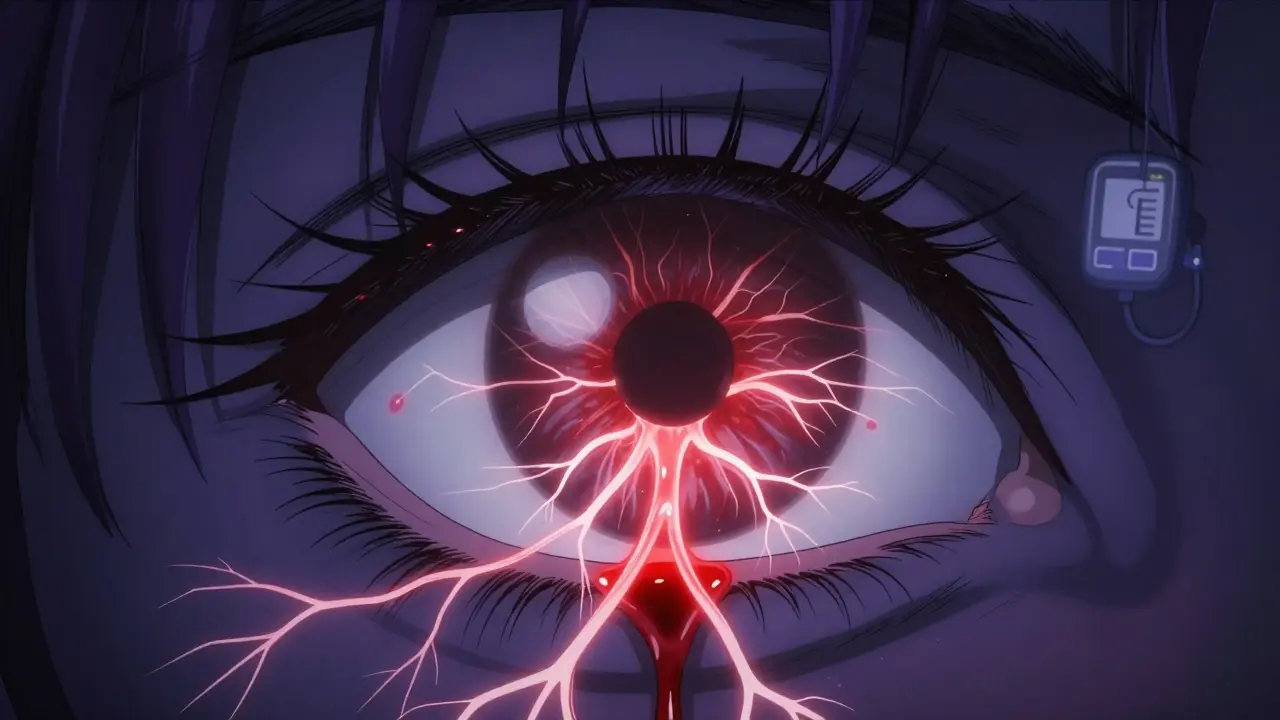
Most people know that high blood pressure can lead to heart attacks or strokes. But few realize it’s quietly eating away at their vision - often without symptoms until it’s too late. Hypertensive retinopathy isn’t just a medical term. It’s the reality for millions of adults whose uncontrolled blood pressure has started damaging the tiny blood vessels in their eyes. And by the time they notice blurred vision or dark spots, the damage may already be permanent.
What Exactly Is Hypertensive Retinopathy?
Hypertensive retinopathy happens when high blood pressure causes the small arteries in your retina - the light-sensitive layer at the back of your eye - to narrow, thicken, or leak. These aren’t major vessels. They’re microscopic, barely visible without special tools. But they’re critical. They deliver oxygen and nutrients to the retina. When they’re damaged, the retina starves. Fluid and blood leak out. Fat builds up. And over time, vision fades.
The damage doesn’t happen overnight. It creeps in over years. Studies show that after just 3 to 5 years of uncontrolled hypertension, retinal changes begin. By 10 years, even "mild" high blood pressure - like 130/85 - can cause visible harm. The American Heart Association calls this a silent warning sign. Your eyes aren’t just seeing the world. They’re showing you what’s happening inside your body.
The Four Stages of Retinal Damage
Doctors use the Keith-Wagener-Barker (KWB) system to grade the severity of retinopathy. It’s simple, reliable, and tells you how far the damage has gone.
Grade 1: The arteries are slightly narrowed. No bleeding or leaks yet. You won’t feel a thing. But an eye exam can spot it. About 22% of people with uncontrolled high blood pressure for 3 years already show this stage.
Grade 2: The narrowing gets worse. Now, you see arteriovenous nicking - where an artery presses down on a vein like a thumb on a hose, pinching off blood flow. This is a red flag. It means your vessels are under serious stress.
Grade 3: This is where symptoms start. You get hemorrhages - tiny bursts of blood in the retina. Cotton wool spots appear - white, fluffy patches where nerve fibers have died from lack of oxygen. Hard exudates form - yellowish lipid deposits from leaking fluid. Vision blurs. Colors look dull. You might notice dark spots in your central vision.
Grade 4: The most dangerous. Now, the optic nerve swells - a condition called papilledema. This means your brain is under pressure too. It’s a sign of malignant hypertension, where blood pressure spikes above 180/120 mmHg. In 40% of these cases, optic swelling happens within 72 hours. And 15% of these patients lose vision suddenly - often describing it like a curtain falling over their eye.
Why Your Eyes Are the First to Warn You
The retina is the only place in your body where you can see blood vessels directly - no surgery needed. That’s why eye doctors call it a "window to systemic health."
When you see retinal changes, you’re not just looking at the eye. You’re seeing what’s happening in your brain, kidneys, and heart. Studies show people with Grade 3 or 4 retinopathy have a 2.5 times higher risk of heart attack or stroke. Those with optic disc swelling are 3.2 times more likely to have a stroke than people with normal retinas.
And here’s the scary part: 68% of people with early-stage retinopathy (Grades 1-2) have no symptoms at all. They don’t feel dizzy. Their headaches are "just stress." They don’t connect blurry vision to blood pressure. By the time they see an eye doctor, it’s often been 18 to 24 months since the first signs appeared.
What Symptoms Should You Watch For?
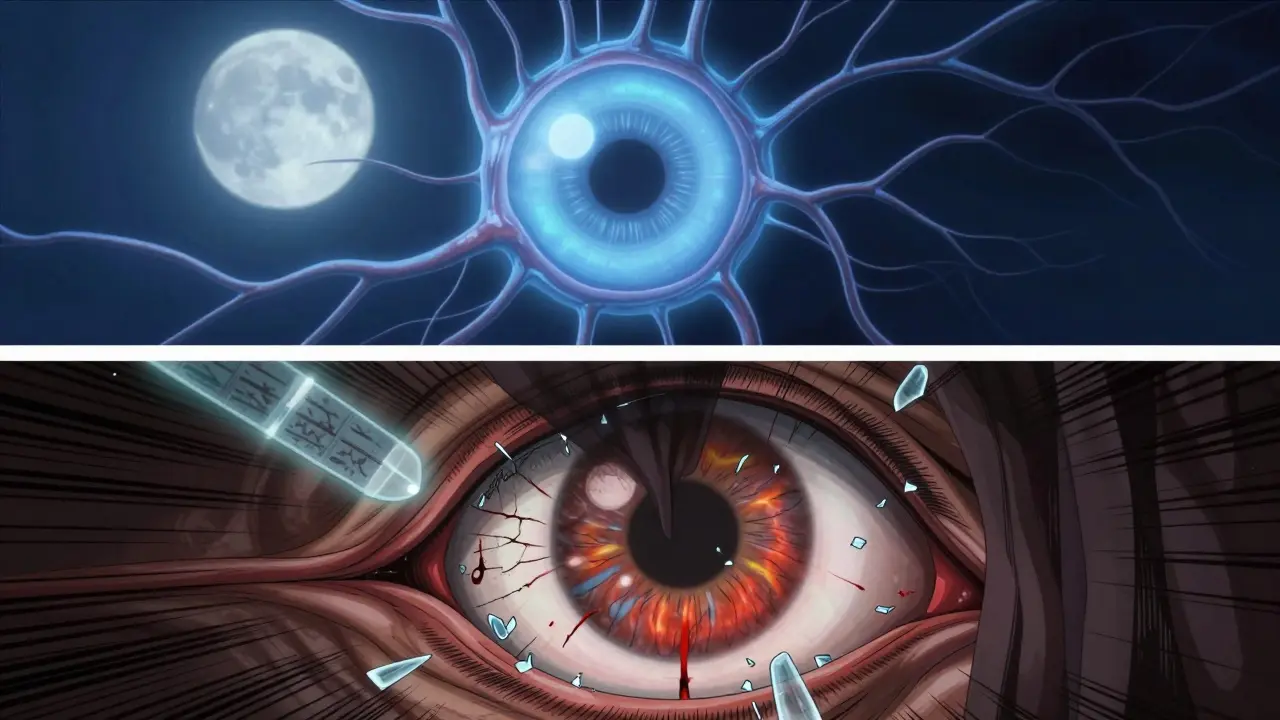
You might not feel anything until it’s advanced. But when symptoms do show up, they’re hard to ignore:
- Blurred or dim vision - especially after a sudden spike in blood pressure
- Dark spots or floaters that don’t go away
- Sudden loss of part of your vision - like a curtain pulling across your field of view
- Double vision with severe headaches - a classic sign of malignant hypertension
- Difficulty focusing or seeing at night
One Reddit user, u/RetinaWarrior, described waking up with "dark spots in the center of my vision" after his blood pressure hit 210/110. Another in the r/Hypertension forum said they got "double vision and a pounding headache" - and didn’t realize it was tied to their BP until their eye doctor pointed it out.
Don’t wait for these signs. If you have high blood pressure, your eyes need regular checks - even if you feel fine.
How Is It Diagnosed?
Your eye doctor uses an ophthalmoscope - a lighted tool - to look at the back of your eye. They’ll check for narrowed arteries, bleeding, swelling, and exudates. But modern tools do more.
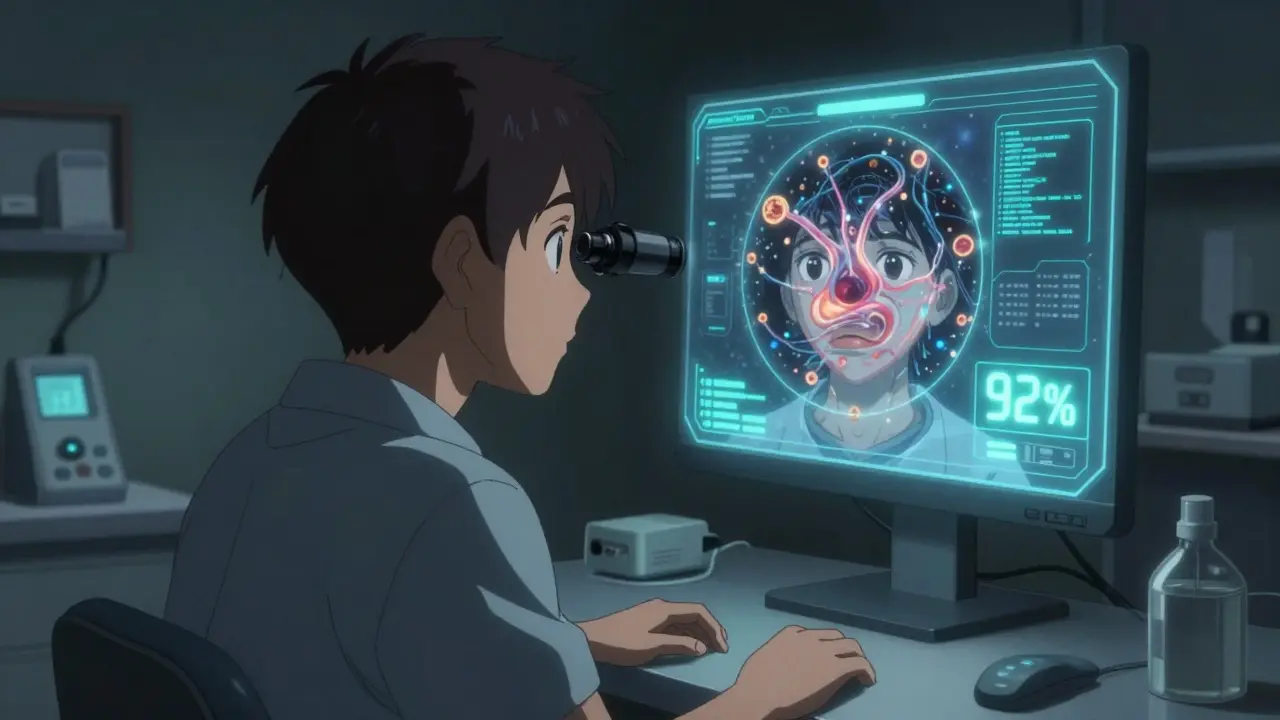
Optical coherence tomography (OCT) scans the retina in microns. It can detect swelling as small as 10-15% thickening before you notice vision changes. New AI systems like RetinaCheck AI, cleared by the FDA in 2022, analyze retinal images and spot early signs with 92% accuracy - up from 75% with human eyes alone.
Some clinics now use non-invasive devices like RetiFlow, which measures blood flow in tiny capillaries without dye. It’s 94% as accurate as traditional angiography - and completely painless.
Can It Be Reversed?
Yes - but only if caught early.
If you’re in Grade 1 or 2, controlling your blood pressure can stop the damage. In 65% of cases, retinal changes begin to heal within 24 to 48 hours of bringing BP down by 25 mmHg. Vision can improve in 7 to 10 days. But if you’ve reached Grade 3 or 4, some damage is permanent.
Macular damage - where the center of your vision is affected - can take 3 to 6 months to partially recover. And 22% of patients still end up with permanent vision loss, even with perfect treatment.
Medications matter too. The European Society of Cardiology found ACE inhibitors reduce retinal damage progression by 32% compared to calcium channel blockers. That’s a big difference. If you’re on BP meds, ask your doctor if yours protects your eyes.
What Should You Do?
Here’s what works, based on real-world data:
- Get your eyes checked yearly - even if your BP is "under control." If you have Stage 2 hypertension (140/90 or higher), get checked every 6 months now, per 2023 AHA guidelines.
- Monitor your BP at home - studies show 70% of people stick to meds better when they track their numbers daily.
- Don’t ignore blurry vision - if it happens suddenly or with a headache, go to the ER. You could be having a hypertensive emergency.
- Know your numbers - systolic over 160 mmHg or diastolic over 120 mmHg for more than 6 months raises your risk of hemorrhages by 35%.
- Ask about retinal screening - if you have diabetes too, your risk of permanent vision loss jumps 4.7 times. You need more frequent checks.
The American Heart Association’s "Check. Change. Control." program found that people who understood the eye-BP link improved their BP control by 35%. Knowledge isn’t just power - it’s vision.
The Bigger Picture
Over 19 million Americans have Stage 2 hypertension. That’s about 7.3% of adults. And nearly one in five of them will develop hypertensive retinopathy. The diagnostic market for this condition is expected to hit $1.8 billion by 2027 - not because it’s trendy, but because we’re finally waking up to what the eyes are telling us.
There’s new research too. The NIH’s RETINA-HTN study, launched in May 2023, is looking for genetic markers that make some people more vulnerable. Early results point to 37 gene variants that might predict who’s at highest risk. That could lead to personalized screening - catching damage before it starts.
But you don’t need a gene test to protect your vision. You just need to know your blood pressure - and act on it.
High blood pressure doesn’t just threaten your heart. It’s stealing your sight, one tiny vessel at a time. And the worst part? You probably won’t notice until it’s too late. But if you check your eyes - and your numbers - you can stop it before it steals anything.
Comments
Chiraghuddin Qureshi
January 21, 2026 AT 21:40Bro, I never knew my eyes were basically a live feed of my blood pressure 😱 I’ve been ignoring my BP for years, but now I’m booking an eye exam this week. My grandma lost her vision like this - I don’t want to repeat history. 🙏🩺
Lauren Wall
January 22, 2026 AT 06:43If you’re not checking your eyes with high BP, you’re just gambling with your vision. No excuses.
Jasmine Bryant
January 24, 2026 AT 05:54Wait, so OCT scans can detect 10-15% thickening before symptoms? That’s wild. I had one last year and my doc didn’t mention anything… maybe I should ask for the report again? Also, is RetinaCheck AI available in community clinics or just fancy hospitals? 🤔
Liberty C
January 24, 2026 AT 20:29It’s frankly scandalous that primary care physicians don’t mandate annual retinal screenings for all hypertensive patients. This isn’t some obscure niche - it’s systemic neglect disguised as medical practice. People are losing their sight because doctors are too lazy to connect the dots. And don’t get me started on how insurance refuses to cover non-invasive RetiFlow unless you’re diabetic. Absurd.
shivani acharya
January 25, 2026 AT 08:17Let’s be real - this whole ‘hypertensive retinopathy’ thing is just Big Pharma’s way of selling more BP meds and OCT machines. Who says those ‘cotton wool spots’ aren’t just stress-induced artifacts? I read a blog by a guy who reversed his BP with Himalayan salt and moonlight meditation. No drugs. No scans. Just vibes. And guess what? His vision cleared up. The system doesn’t want you to know this. They profit from your fear. 😏
Sarvesh CK
January 26, 2026 AT 23:13It is a profound insight that the retina functions as a biological mirror of systemic vascular health. The microvasculature of the eye, being acutely sensitive to hemodynamic stress, offers an unparalleled window into the integrity of the broader circulatory system. One cannot help but reflect on the ethical imperative to integrate routine ophthalmoscopic screening into standard hypertension management protocols - not as a luxury, but as a non-negotiable component of preventive care. The silence of this condition is not benign; it is a systemic failure of awareness.
Daphne Mallari - Tolentino
January 28, 2026 AT 15:19While the article is technically accurate, it lacks any discussion of socioeconomic disparities in access to retinal imaging. In underserved communities, even basic ophthalmoscopes are scarce. To suggest ‘yearly eye exams’ as a universal solution is to ignore the structural realities faced by millions. This is not medicine - it’s privilege dressed in clinical language.
Neil Ellis
January 29, 2026 AT 20:19Man, this hit different. I used to think ‘low BP’ meant I was healthy - turns out my ‘chill’ lifestyle was just ignoring a ticking time bomb. Got my first OCT scan last month - Grade 1, but I’m on ACE inhibitors now and checking my BP twice a day. Vision’s already sharper. Don’t wait for the curtain to fall. You’ve got control. Just start.
Rob Sims
January 29, 2026 AT 22:09Oh wow, so people with Grade 3 retinopathy are just dumbasses who didn’t take their meds? Congrats, you’re now a walking medical case study. Maybe if you didn’t eat 3 pizzas a week and slept like a rock, you wouldn’t need a $2000 eye scan to tell you you’re dying slowly.
arun mehta
January 30, 2026 AT 11:32Thank you for this meticulously detailed and scientifically grounded exposition. I have shared this with my entire family, including my elderly parents who have been managing hypertension for over two decades. The integration of AI-assisted diagnostics like RetinaCheck AI and non-invasive tools such as RetiFlow represents not merely technological advancement, but a moral obligation to preserve human dignity through early intervention. Let us not underestimate the power of awareness - it is, indeed, vision.