
Chronic Fatigue Syndrome: Symptoms, Pacing, and Clinical Evidence

Chronic Fatigue Syndrome, now more accurately called Myalgic Encephalomyelitis/Chronic Fatigue Syndrome (ME/CFS), isn't just feeling tired. It’s a debilitating, long-term illness that turns everyday life into a minefield. You wake up exhausted. You walk to the kitchen and your body shuts down. A shower leaves you bedridden for hours. Mental tasks like reading or talking on the phone feel like running a marathon. And the worst part? Rest doesn’t fix it. In fact, doing too much-even a little-makes it worse. This isn’t laziness. It’s not depression. It’s a real, measurable disease with clear biological changes in the brain, immune system, and energy production.
What Makes ME/CFS Different from Regular Fatigue?
Everyone gets tired. But ME/CFS is defined by one core symptom: post-exertional malaise, or PEM. This isn’t just feeling worn out after a long day. It’s a severe, unpredictable crash that hits hours or even days after physical, mental, or emotional effort. Think of it like this: a healthy person might feel sore after a hike. Someone with ME/CFS might need three days to recover from walking to the mailbox. The crash lasts longer than 24 hours, often dragging on for days or weeks. It’s not just fatigue-it’s a whole-body collapse.
The other symptoms pile on top of PEM. You’ll likely have trouble remembering things, focusing, or finding the right words. Sleep doesn’t refresh you-you wake up as drained as when you lay down. You might get unexplained muscle pain, joint pain without swelling, headaches that feel different from before, or sore lymph nodes. Some people feel dizzy when standing up. These symptoms aren’t occasional. They occur at least half the time, for six months or longer. And they’re severe enough to cut you off from work, school, or social life.
Why Diagnosis Takes Years
Most people with ME/CFS wait over five years to get a diagnosis. Why? Because doctors often don’t recognize it. In a 2023 survey of patients on Reddit, 82% said their symptoms were dismissed as anxiety or depression. Many physicians still think it’s "all in your head"-even though science has moved far beyond that.
There are three main diagnostic criteria used today. The CDC’s older criteria list eight symptoms and require four to be present. But this catches too many people who don’t have ME/CFS. The 2015 IOM criteria are tighter: you need severe fatigue, PEM, unrefreshing sleep, and either cognitive problems or dizziness when standing. It’s better for primary care, but misses people whose main issue is dizziness without brain fog. The strictest is the International Consensus Criteria (ICC), which puts PEM at the center and demands problems in at least four systems: neurological, immune, gastrointestinal, and energy metabolism. It’s the most accurate but hardest to apply in a 15-minute doctor’s visit.
And here’s the kicker: there’s no blood test. No MRI that screams "ME/CFS." Diagnosis is still based on ruling out other conditions-like thyroid disease, Lyme, or sleep apnea-and matching your symptoms to these criteria. That’s why so many patients go from doctor to doctor, getting tests that come back normal, and feeling like they’re being ignored.
The Science Is No Longer Debated
For decades, ME/CFS was treated like a mystery. Now, it’s one of the most studied chronic illnesses-with hard evidence backing it up.
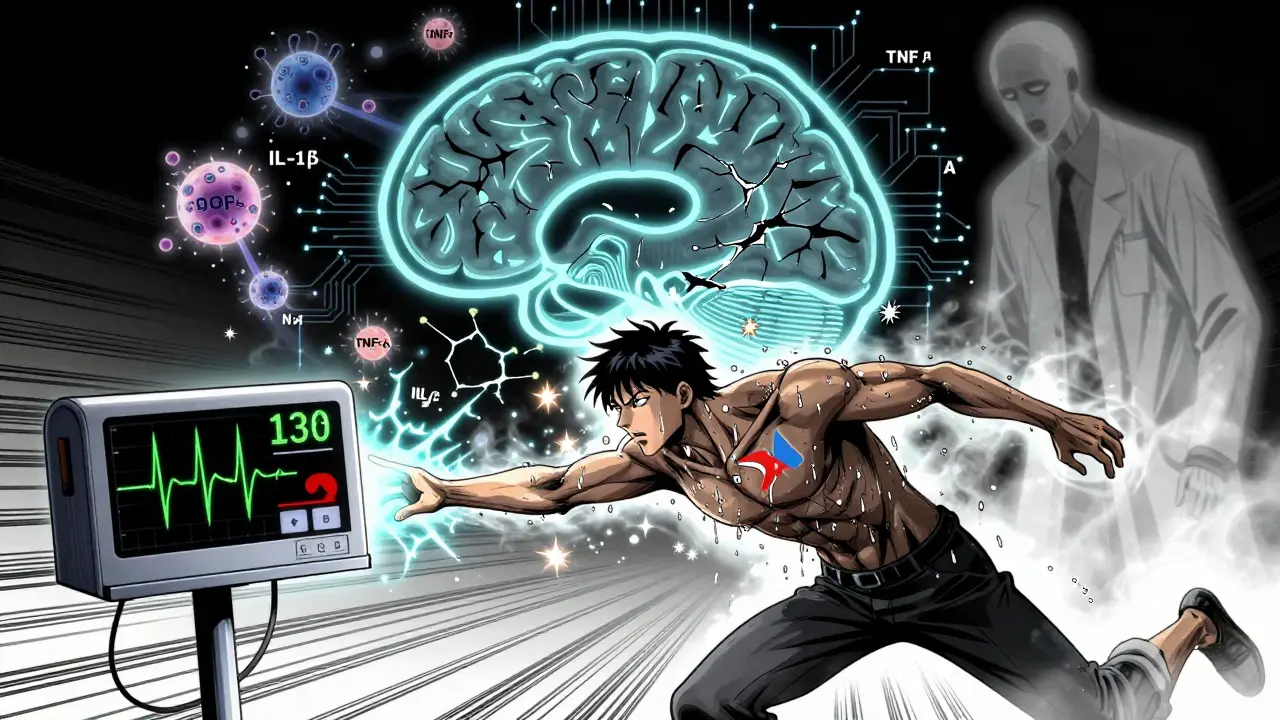
Advanced brain scans show clear changes. In a 2022 study of 312 patients, researchers found reduced connectivity in the brainstem and hippocampus-the areas that control alertness, memory, and stress response. The worse the symptoms, the more the brain wiring was disrupted (r=0.78, p<0.001). That’s not random. That’s a measurable, physical difference.
Immune systems are stuck in overdrive. During PEM episodes, levels of inflammatory proteins like IL-1β and TNF-α rise by over 35%. Your body is literally fighting itself, even when you’re not sick.
Your energy system is broken. Mitochondria-the power plants in your cells-produce 28% less ATP, the molecule that fuels every movement, thought, and heartbeat. After light exercise, lactate builds up 50% slower than in healthy people, meaning your body can’t clear waste products efficiently. Your muscles literally can’t recover.
Your autonomic nervous system is out of whack. Heart rate variability drops by 35% when you stand up. That’s why so many people with ME/CFS feel faint or lightheaded. It’s not anxiety. It’s your body losing control of basic functions like blood pressure and heart rate.
And the evidence keeps growing. In 2023, the NIH funded $15.2 million in new research. The FDA now requires objective PEM measurement via two-day exercise tests for any new drug trial. This isn’t speculation. It’s science.
Pacing: The Only Proven Strategy
There are no approved drugs. No cure. But there is one thing that works: pacing.
Pacing isn’t just resting more. It’s learning to live within your energy limits-before you crash. Think of your energy like a budget. Healthy people have 24-30 "spoons" a day. Someone with ME/CFS might have 8. Every activity costs spoons: brushing your teeth = 1 spoon, showering = 3, cooking dinner = 5. Once you’re out, you’re done. No borrowing. No overdraft.
Studies show that people who use pacing reduce crashes by 45%. The key is staying below your threshold. Most people start by cutting activity to 50-60% of what they think they can handle. Use a heart rate monitor. Keep your heart rate under 120-130 bpm during activity. That’s usually below your anaerobic threshold-the point where your body starts to struggle. One study found that real-time heart rate feedback cut PEM episodes nearly in half.
It’s hard. The first few months are brutal. You’ll think, "I feel okay today-I’ll do more." Then you crash. That’s the boom-bust cycle. 89% of newly diagnosed people go through it. But over 6-9 months, you learn your true limits. You start to predict what will trigger a crash. You learn to say no. You protect your energy like gold.
Specialized clinics like the Bateman Horne Center report that 65% of patients see a 30% improvement in symptoms within six months of proper pacing. That’s not a miracle. That’s science. And it’s the only treatment with consistent, reproducible results.

Why Exercise Therapy Can Make Things Worse
For years, doctors told people with ME/CFS to "get more exercise." Graded Exercise Therapy (GET) was the standard. It was based on the idea that fatigue was caused by deconditioning. It wasn’t. A 2021 trial called STOP ME/CFS showed that 37% of patients on GET got worse. Only 12% of those doing pacing alone had the same outcome. The exercise didn’t help-it broke them.
Why? Because ME/CFS isn’t about weak muscles. It’s about energy failure. Pushing through fatigue doesn’t build strength-it triggers immune and nervous system chaos. That’s why the CDC’s 2023 toolkit now explicitly warns against exercise programs for ME/CFS. The message is clear: don’t push. Protect.
What’s Next?
Research is accelerating. The NIH launched a $17.8 million network in 2022 with five major research centers. Studies are now looking at gut bacteria, metabolic reprogramming, and immune reset therapies. The first FDA-approved clinical trial endpoints now require objective PEM measurement. That means real drugs are on the horizon.
But until then, pacing is your best tool. Track your energy. Use apps like Fatigue Tracker or ME/CFS Manager. Keep a diary. Learn your triggers. Build a support system. And if a doctor tells you to "just exercise more," walk out. You know better now.
This isn’t a life sentence. It’s a new way of living. One where you listen to your body-not ignore it. And with every passing year, science backs you up more.
Is ME/CFS the same as chronic fatigue?
No. "Chronic fatigue" is a symptom that can happen in many conditions-like cancer, depression, or sleep apnea. ME/CFS is a specific disease defined by a cluster of symptoms, with post-exertional malaise (PEM) as the core feature. It’s not just tiredness. It’s a multi-system illness with measurable biological abnormalities.
Can you recover from ME/CFS?
Recovery looks different for everyone. Some people improve significantly with proper pacing and support, returning to part-time work or regular activities. Others stabilize and learn to manage symptoms long-term. A small percentage experience full remission, especially if diagnosed and managed early. Studies show that early intervention-within the first three months of onset-can improve long-term outcomes by 40%. But there’s no guaranteed cure. The focus is on managing the illness, not just waiting for it to disappear.
Why is PEM so important in diagnosis?
PEM is the defining feature of ME/CFS. It’s not just fatigue after activity-it’s a disproportionate, delayed crash that lasts days. Research shows it’s linked to real physiological changes: reduced oxygen use, abnormal heart rate recovery, and immune spikes. Without PEM, you don’t have ME/CFS. That’s why the 2015 IOM criteria and the ICC both make it mandatory. It’s the symptom that separates this illness from others.
Are there any medications that help?
There are no FDA-approved drugs specifically for ME/CFS. Some people find relief from symptoms using off-label treatments: low-dose naltrexone for immune modulation, fludrocortisone for blood pressure, or stimulants for brain fog. But none target the core problem. Clinical trials for drugs like Ampligen (Rintatolimod) showed 35% symptom improvement in phase 3 studies, but they’re not yet approved. The focus remains on non-drug strategies like pacing, sleep hygiene, and managing orthostatic intolerance.
How do I find a doctor who understands ME/CFS?
Start with specialized clinics like the Bateman Horne Center or the ME/CFS Collaborative Research Centers at Stanford, Cornell, or Harvard. Many patients find support through advocacy groups like MEAction or the ME Association. Look for doctors who mention PEM, pacing, and autonomic dysfunction in their practice descriptions. Avoid providers who push exercise therapy or label your illness as psychological. If a doctor doesn’t know about the 2023 CDC toolkit, they’re likely not up to date.

Comments
Nishan Basnet
March 23, 2026 AT 01:33As someone who’s lived with this for over a decade, I can say pacing isn’t just advice-it’s survival. I used to think I could push through the fog, but every time I did, I lost weeks. Now I track my heart rate like a hawk. If it hits 115, I stop. No excuses. No guilt. My energy isn’t infinite, and pretending it is only makes the crash worse. I’ve gone from bedridden to managing part-time remote work-not because I got cured, but because I finally stopped fighting my body.
It’s not about being lazy. It’s about being smart.
And yeah, doctors still don’t get it. But we do.
Johny Prayogi
March 23, 2026 AT 07:54THIS. I’ve been saying this for years. 🙌
PEM isn’t ‘tired’-it’s a neurological fire drill. Your body doesn’t just need rest. It needs a ceasefire.
Also-no, I won’t do yoga. No, I won’t ‘just try harder.’ I’ve got a 30-spoon budget and I’m not overdrawing.
Also also-why is this still not covered by insurance? 😤
shannon kozee
March 23, 2026 AT 13:55Heart rate monitoring changed everything for me. Started at 120 bpm threshold. Now I stay under 110. No more 3-day crashes. Just steady, quiet living. It’s not glamorous, but it’s mine.
And yes, I still get side-eyed at the grocery store for sitting down while shopping. Whatever.
Natali Shevchenko
March 25, 2026 AT 12:54I’ve been reading up on mitochondrial dysfunction in ME/CFS for the past year, and honestly? The science is breathtakingly elegant. It’s not that your cells are broken-they’re just starved of the right signals. ATP production isn’t low because you’re lazy. It’s low because your body’s alarm system is stuck on ‘DANGER: ENERGY DEPLETION.’
Think of it like a power grid that’s been overloaded so many times it’s now in permanent brownout mode. You can’t just flip a switch. You have to rewire the whole system slowly, carefully.
That’s why pacing works. It’s not rest-it’s circuit protection.
And yes, I’ve read the 2022 brain connectivity paper. The hippocampal disruption? That’s why I can’t remember my own phone number after a 10-minute conversation. It’s not dementia. It’s dysautonomia in disguise.
What’s wild is how many people still think this is a mental health issue. We’ve got fMRI scans, cytokine profiles, lactate kinetics, and autonomic metrics-all pointing to one thing: this is a systemic bioenergetic disorder. Not a mindset. Not a personality flaw. Not a ‘lack of motivation.’
And yet, the medical establishment still treats it like a myth. It’s like diagnosing diabetes by asking if you ‘feel like eating sugar.’
I don’t know if we’ll ever get a cure, but I do know we’re closer than ever. The NIH funding surge? That’s the first real sign that the tide is turning. Maybe in 10 years, kids with early-stage ME/CFS won’t have to beg for validation. Maybe they’ll get diagnosed before they lose their lives.
Until then, I’ll keep tracking my spoons. And my heart rate. And my rage.
They’re all connected.
Nicole James
March 25, 2026 AT 14:16Wait… so you’re telling me… the government funded $17.8 MILLION… and yet, the CDC still says ‘rest’ is the solution? 🤔
Who’s really behind this? Big Pharma? The insurance industry? The chiropractors who sell ‘energy balancing’ bracelets?
I’ve been researching this since 2018. I’ve read every paper. Every whistleblower. Every leaked email.
They don’t want us to recover. They want us to stay sick. So we keep paying for ‘symptom management.’ So we keep taking pills that don’t work. So we keep being told to ‘exercise more’ while our mitochondria scream in silence.
It’s not a disease.
It’s a cover-up.
And the FDA? They’re just the gatekeepers. Waiting. Watching. Profiting.
Who benefits? Who benefits when 82% of patients are gaslit into silence?
…I’ll be waiting for the whistleblower.
And I’m not alone.
Jackie Tucker
March 26, 2026 AT 07:36Oh wow. A 12-page manifesto on how to not do anything.
How revolutionary. I’ve been pacing my… uh… existence for years. Thanks for the tip, doctor.
Also, I’m pretty sure ‘spoons’ was invented by a Tumblr user in 2014. And now it’s gospel? Cute.
And the heart rate monitor? How quaint. Next you’ll tell me to wear compression socks and drink kombucha.
Meanwhile, I’ll be over here, actually working.
Just saying.
Thomas Jensen
March 27, 2026 AT 16:17They don’t want you to know this, but ME/CFS is linked to 5G. And the vaccines. And the water supply. And the fluoride. And the fact that they’ve been injecting microchips since 2010. The brain scans? That’s just the signal being blocked. The mitochondria? They’re being jammed by EMF. The immune system? It’s being hijacked by the WHO’s secret agenda.
Why do you think they call it ‘chronic fatigue’? So you think it’s normal. So you don’t ask questions.
I’ve been on a 12-year journey. I’ve met others. We’re all connected. We’re all being monitored.
But now… I’m awake.
Are you?
Solomon Kindie
March 29, 2026 AT 00:24Pacing? Sounds like giving up. Why not just tough it out? I mean, people in the 80s didn’t have all this tech. They just worked. You think they had heart monitors? No. They had willpower.
Also, if you’re so tired, why are you even online? Shouldn’t you be resting?
Just saying.
Also, I read one study that said 3% of people ‘recover.’ So maybe you’re just not trying hard enough.
Also also, I’ve been to the doctor. They said I had anxiety. So I’m good.
Peace.
Casey Tenney
March 29, 2026 AT 12:47Don’t push. Protect. That’s it.
Stop pretending you’re a hero.
Just stop.
Timothy Olcott
March 30, 2026 AT 06:09Y’all need to chill. This isn’t a cult. It’s a medical condition. I’m from the Midwest. We don’t do emojis. We don’t do ‘spoons.’ We just work. My grandpa worked 70 hours a week with a broken back. You think he had a heart rate monitor? Nah. He had grit.
Maybe you’re just weak.
Also, I got ME/CFS after the vaccine. So I know what’s up.
Also also, I’m not mad. I’m just disappointed.
Desiree LaPointe
March 31, 2026 AT 08:27Oh, so now we’re all supposed to be scientists? Tracking heart rates? Monitoring ATP production? How cute. Did you get your PhD from TikTok?
Let me guess-you also meditate with crystals and drink bone broth while chanting ‘I am energy’ in front of a mirror.
Meanwhile, real doctors are still trying to figure out why your ‘fatigue’ is suddenly a multi-system disorder.
And you call this science?
Pathetic.
matthew runcie
March 31, 2026 AT 20:58Thanks for laying this out clearly. I’ve been in this for 8 years. Pacing saved me. Not because I’m special. But because I finally listened.
And yeah-some days are still rough.
But I’m here.
And that’s enough.
trudale hampton
April 2, 2026 AT 19:18I used to think I was broken. Now I know I’m just wired differently.
My energy isn’t a faucet. It’s a battery. And I’m learning how to charge it slowly.
Still have bad days.
But I’m not alone anymore.
Shaun Wakashige
April 4, 2026 AT 02:41lol i just read this whole thing
im tired
Paul Cuccurullo
April 5, 2026 AT 21:30It is profoundly moving to witness the convergence of clinical evidence and lived experience. The biological underpinnings of ME/CFS-particularly the dysregulation of autonomic and mitochondrial function-represent a paradigm shift in our understanding of chronic illness.
It is both a scientific triumph and a moral imperative that we now recognize this condition as a legitimate, measurable, and treatable disorder.
Let us continue to advocate with compassion, rigor, and unwavering resolve.
Bryan Woody
April 7, 2026 AT 05:51My husband has ME/CFS. He went from running marathons to needing help to get out of bed. We found a specialist. We started pacing. Three years later, he can cook dinner without crashing. It’s not perfect. But it’s progress.
Thank you for this. We’re not alone.